Chapter One. (Part Four.)
West Midlands.
Birth & Rebirth.
Tamworth.
As I drive on through the outskirts of Coventry, I’m struck by the realisation that my journey today has been plagued by a flanking procession of flags unlike any I have experienced at home. Throughout the cities, satellite towns, and villages that populate the West Midlands, a great minority of lampposts on the main roads have been flying the red and white of St George and the additional blue of the Union Flag — only called the Union Jack when it’s flown at sea, though the perpetrators surely do not make this distinction, nor do they notice that a great number have been flown upside down, the sign of a country in distress. I thank the childhood years spent in the Sea Scouts for this obscure flag knowledge. I know it makes this aside rather dorky, but if you’re gonna fly a flag, fly it right.
I make no comment on those who have hoisted the colours or their intentions — because I don’t have to. All I will speculate, and hope, is that these ‘patriots’ are simply overzealous in their preparation for, and celebration of, the upcoming Football World Cup, where England, Scotland, and potentially Wales and Northern Ireland will all have the honour of competing. A clean qualification sweep is on the cards for the home nations for the first time in 68 years, since Sweden in 1958 — though if it goes the same way as that tournament, these English hooligans will have very little to celebrate, as the Three Lions went out in the group stages while it was Wales and Northern Ireland who reached the quarter-finals.
On this drive to my final destination, down dark and winding, snow-blanketed country roads for the most part, these flags flying Christian heraldry get me thinking. Thinking not just about the motivations of the men — I assume they’re all men, creating a certain caricature in my mind — who have raised these colours in the 21st century, but of the nobler, yet in truth no less prejudiced, Mercian kings (and Queen) of the Dark Ages who fought and schemed so energetically to keep out that legendary flood of immigrants arriving in their boats on these shores. The pagan Danes and Norsemen who came to Viking – literally to raid in Old Norse - along this coast came also to settle, in search of a better future rather than to scratch a living from poor lands and pillage.
Those ancient rulers of the Saxon kingdoms of Engla Land fought so hard and for so long to hold back the influence of these people from across the water, not for the protection and betterment of the Angelcynn — the English people — but to hold on to their power over them. Sounds familiar.
I pull my car down a tight lane, following the robotic voice emanating from my maps app, which drowns out the dulcet tones of Amy Winehouse I had been singing along to, the wheels rattling over the aged cobblestones and drowning out any further notes I try to pick up. The car park is just down here on the left, it says. The castle car park. So I turn right when I’m told and pull in under the gatehouse with its great studded timbers and wrought-iron portcullis — a truly grand entrance to a car park, if ever I have seen one.
My attention is wrestled from the garden path ahead to the commanding sight looming over me from the hillock to my left. Wait — garden path? I snap my eyes back down to ground level where flower beds and park benches hem in both sides of the path I am driving along. I’ve driven not into the car park but into the castle grounds themselves.
I half expect a security guard to pop out of the gatehouse behind me, clad in chain mail and waving a longsword above his head, ready to admonish me for my stupidity as arrows flick down at my car from the castle battlements above. But the grounds are deathly quiet, not a soul in sight among the biting ice fog and oppressive darkness of this winter evening. I reverse slowly but deliberately back under the gatehouse and onto the lane beyond, praying all the while to whoever will listen that I do not hit the centuries-old stonework on either side — for I know it is undoubtedly stronger than the flimsy metalwork of my Mini Cooper, that I will come off worse and still get the blame, and the fine to go with it.
Back on the cobbled lane, I take a breath and look ahead to see the castle car park clearly signposted as the next left and looking, unsurprisingly, like a car park. It even has a few cars in it, and all sorts.
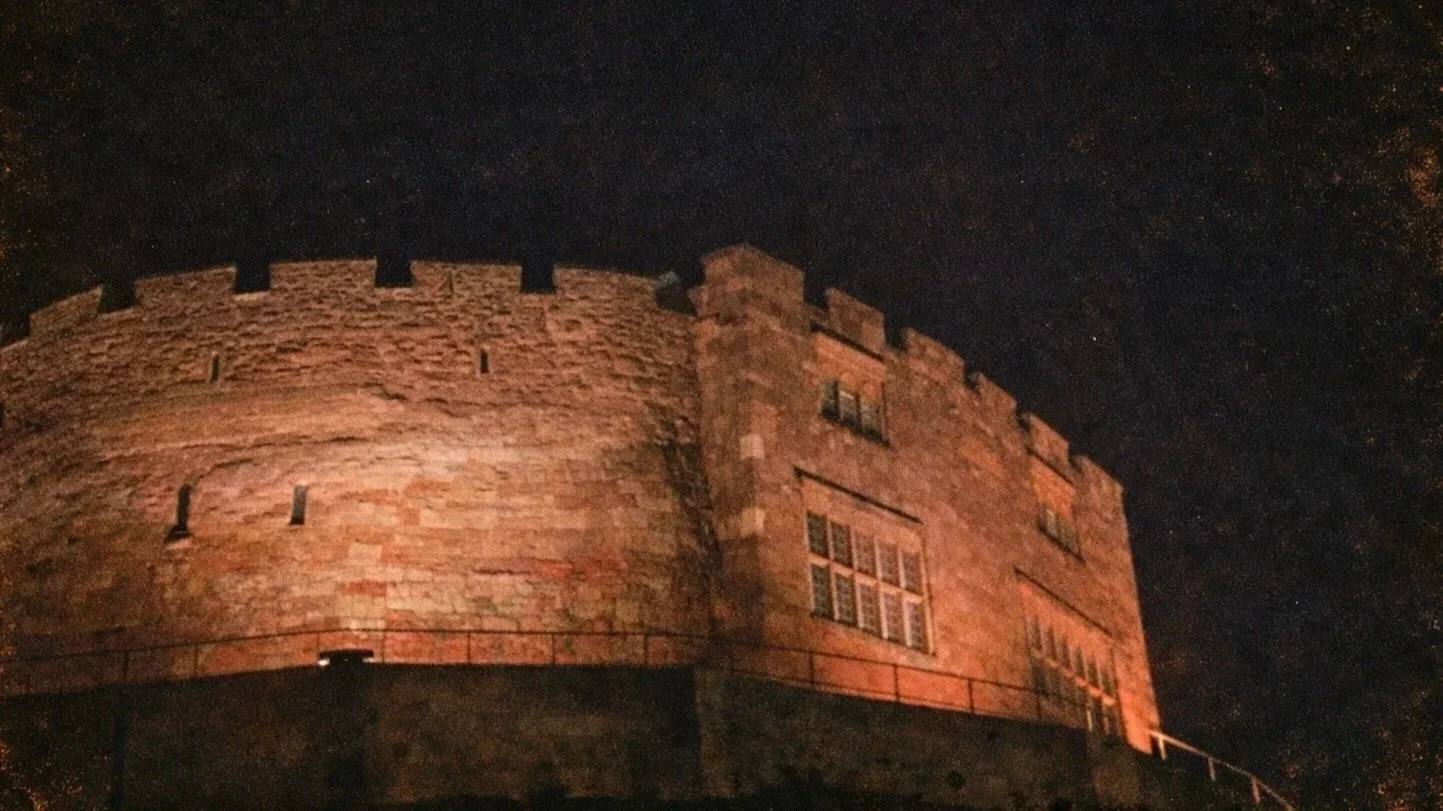
Back in the castle grounds, having ventured this time unshielded under the gatehouse defences, I take my time looking up and drinking in the view before me. The hulking mass perched on the hill above is low and sturdy, like a front-row bruiser, in contrast to the fairytale image of castles you know as a child — elegant and tall, perched up high in the mountains. Even in the cold January night, its red stone walls, baked in smouldering orange light, shine out as a beacon of power and stability to the surrounding landscape, the battlements cutting a sharp silhouette against the clear, ice-cold black sky above.
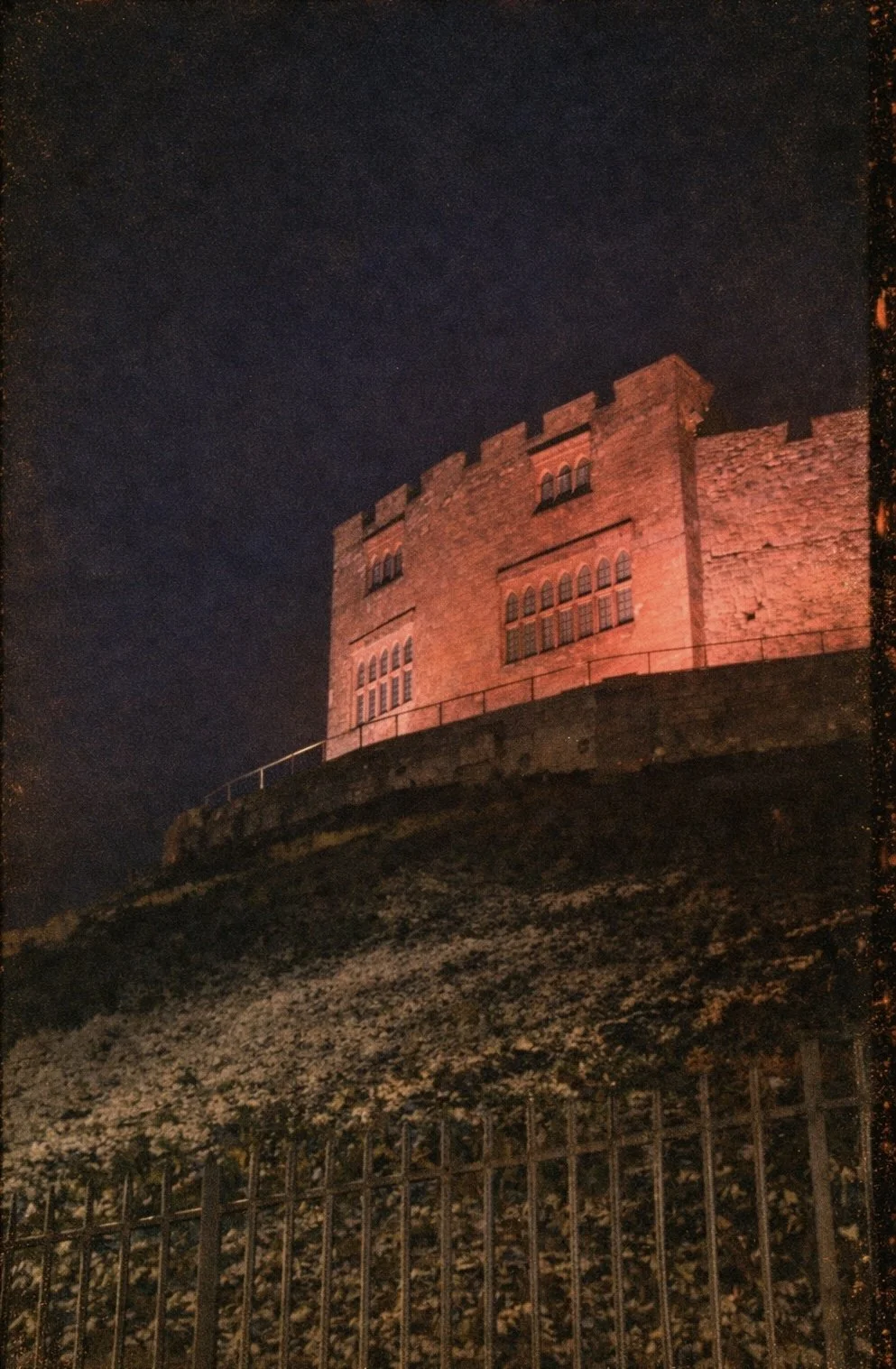
Standing here among the freezing fog clouding the grounds around the hillock, I imagine it must look like a moat of swirling cloud from up there on the battlements. But I will never know for sure, as the paths leading up to the hilltop are barred by padlocked gates — for once again, I have arrived too late at my destination.
My interest is drawn away from the defensive centrepiece at the top of the hill towards an iron statue of a dominant figure standing proud on a plinth, keeping a protective gaze sweeping over the grounds and beyond the outer walls. Æthelflæd, daughter of Alfred the Great and England’s forgotten queen, fortified her capital, Tamworth, in 913 AD when she ruled the kingdom of Mercia alone following the death of her husband, Æthelred. She followed this up with orders to her lords to fortify the major towns throughout her lands against the Danish threat.
Towns like Warwick were first fortified during this defensive mobilisation, that city now home to its own grand castle which draws vast crowds of visitors to its dungeons and jousting competitions, while the grounds of its liege lord sit largely unvisited. Apart, that is, from a lone stranger taking notes in the dark – me - and a group of local kids huddled together on a bench, sipping from a glass Glen’s flask and sending clouds of sweet smoke into the fog around them.
I read these tales of her rule from the information board below her statue, its words faded with time and lack of upkeep. Who are they keeping up appearances for? They should be keeping them up for the memory of Æthelflæd; a great woman of history, a great ruler with grand ambitions. Under her rule, Derby was recaptured from the Danes in 917 AD, and a year later the great Viking stronghold of Leicester fell the same way. A string of towns and cities would follow during her time as ‘Lady of the Mercians’.
Æthelflæd laid the foundations for the kingdom that would go on to become England. On her deathbed, the Vikings of York - who ruled over the kingdom of Northumbria - offered her their loyalty, uniting north and south under one banner for the first time since the foreign rule of the Roman Empire. I learn that her nephew, Æthelstan, was raised by her here at Tamworth, learning statecraft and the rule of law from this remarkable woman before he would go on to become Æthelstan the Glorious, the first king of a united England.
Æthelflæd was more than aware of the dangers posed by the warring Vikings sweeping through the Saxon kingdoms. She had been present when her father’s army was broken by the Great Heathen Army and the subsequent royal retreat into the marshes of Somerset as his kingdom was overrun by hordes of Northmen. But she was likewise keenly aware of the potential for peaceful integration and cultural enrichment offered by the Danish and Norse people who were beginning to settle in the foggy, boggy, green and pleasant lands of England.
I’ll not beat around the bush — here’s a list of all the things these foreign invaders brought to England when they settled here. They were far from the bearded savages the clergy and ruling elite of the time, and film and television today, often portray them as. The Northmen brought better ironworking methods and more efficient farming practices. They influenced storytelling traditions through their epic sagas and introduced words like sky, knife, bread, skin, fellow, weak, wrong, and law — everyday words, basic but fundamental to our lives today.
Many of these words entered English through the Norse introduction of accessible legal culture and local courts which they implemented into the communities they settled in. The word law comes directly from the Old Norse laga, meaning “something laid down”. The Danes also brought strong maritime trade networks and shipbuilding practices which would become integral to Britain’s future. The English had no standing navy before the Viking threat necessitated one, and this early influence would prove essential in shaping Britain’s future imperial power and its ability to defend its people for centuries.
Funnily enough, the Danes and Norsemen were also rather fond of a bathe and a wash — something Anglo-Saxon clerics complained made them more attractive to English women — while the native Anglo-Saxons believed bathing opened pores and let illness in. How times change.
Citizens from throughout the Empire answered the call of the British government in the aftermath of devastation following six brutal years of war and came to these shores in their thousands to rebuild our towns and cities, our industries, our homes, and our society — inspiring a rebirth of British culture, the birth of post-colonial Britain. Those who arrived at ports throughout the land, on ships such as the Windrush, went on to add immeasurably to British culture through art, music, food, and so much more. This is before even accounting for the thousands of men from the Commonwealth who gave their lives in defence of European and global liberty on the battlefields of Europe, North Africa, and in the Pacific theatre.
Britain won that war — and the one before — thanks to the efforts of its Empire. Without the Commonwealth, and without the aid and sacrifice of so-called ‘foreigners’, Britain would surely have fallen. Britain’s imperial history is plagued and marked by the bubonic boils of its rampant disregard for the cultures it conquered, and by the unrestricted pillaging of riches and spoils that each new colony made possible for the Empire. My own ancestral history is a source of internal turbulence and questioning. As a man of mixed Māori and British heritage, there is — and always will be — a mental tug-of-war when coming to terms with the conflagration of imperial history.
My whakapapa — my Māori ancestors — knew the strong arm of the Pākehā - mythical, human-like beings with fair skin and hair, or in other words, white Europeans - who came to the shores of Aotearoa in their ships and claimed the land as their own, fobbing native peoples off with phony contracts written in a language they could not understand, and in terms they could not comprehend. Like so many cultures, the Māori people were taken advantage of and discriminated against — a struggle which continues to this day across the former colonies — an experience mirrored throughout the so-called ‘Commonwealth’.
Don’t get me wrong, I am more than aware of how I look. I identify as a white British male on all my forms and have never experienced discrimination in school, the workplace, or society in general — other than for being a bit of a chubby kid — so my making this point may seem a little bit conceited when taken in comparison with the descendants of immigrants from the Commonwealth who have, and continue to, face racial profiling to this day. Regardless, it is a chapter of my ancestral story full of mixed emotions and deep-rooted questions about personhood, identity, and conflict.
So the benefits of Britain’s Empire—during and after the imperial age—and the salvation of the homeland by its colonies during the Second World War must be discussed in parallel with the almost immeasurable negatives brought about by British rule, imposed on the peoples of an empire upon which “the sun never set”. In fact, Britain was still paying off its war debts to its Commonwealth partners and former colonies until 2006; an economic feat that would not have been possible without the immigration of people from across the Empire and all that they brought with them to these shores.
I break from my internal diatribe, the stabbing cold of the world around me weighing down on my being, and wander over to one final information board — but its secrets are withheld from me. The powdered snow covering its words has turned to sharp ice in the freezing air. I try to rub it clear, but the shards cut and scratch at my hand, turning it numb and stinging deep into my bones. I can’t wait for the summer months of this adventure; beers by the seaside and walks at sunset sound irresistibly appealing right now.
It’s time to warm my body and soul, so I set off with a determined stride in search of that staple of British culture — the national dish, loved throughout the land by free-thinking people and bigots alike. A curry.
Up the hill and out through the other gatehouse, I find myself deposited onto Tamworth’s market street, in the centre of what must once have been a bustling medieval town. Tonight, it is deserted, save for a lonely tent erected in the arcade beneath the neoclassical town hall, pitched between the Greco-Roman pillars. I can hardly imagine the plight of its occupant as the wind whips through the open air, putting my own struggles with the cold night into stark context.
My destination is a mere two-minute walk away, past the darkened windows of local pubs — doors closed firmly against any weary passing travellers — and the synthesised ringing of slot machines spilling out from the pool hall. I wander up the quiet streets, not a soul in sight, up past four open curry houses, skidding slightly and swinging my arms for balance as I tread on a spot of black ice. No one is around to bear witness to my involuntary jig, thank goodness.
I step on into the night more cautiously now, my haste duly chastened, until I reach Jalali, housed grandly in an old chapel—though I later discover it has not been a place of Christian worship for many years, and was once home to a well-known record shop in the 1970s and ’80s. Upon entry, I am wrapped in a comfortable fug, the warmth enhanced by the welcome of the patron. With smiles all round, I am shown to my solitary table, past the golden pagoda holding court at the centre of the room, complete with elephant-headed fountains spouting water from their trunks.
As a solo diner, you grow accustomed to being tucked away in a back corner — this time beside the bustling clatter of pots and pans from the kitchen — but I don’t mind. My position allows me to take in the full vista before me, the stage on which this well-rehearsed performance plays out night after night.
I feel I must be sensible and order a soft drink when I am probed for a decision on my beverage of choice by my smiling waiter. The day has already been a long one, and there is still a long drive home after this final experience. I would dearly love to tuck into a cold Cobra beer—and my waiter knows it, even double-checking my resolve—but I stand firm.
That beer is the archetypal curry-night tipple, known across the country. “Where there’s spice, there’s Cobra” is the tagline coined by Lord Karan Bilimoria, who sought a smoother beer to complement the cuisine of his home on the subcontinent. Though conceived in India with Indian palates in mind, it was always destined for the imperial heartland. Today it is brewed in not-so-exotic Burton-upon-Trent, just twelve miles as the crow flies from where I now sit, craving its ambrosial crispness.
In fact, I would not even have to leave the region of my current adventure to find the source of this “impossibly smooth” beer, now so far removed from its origins in the ‘Garden City’ of Bangalore, where average temperatures hover around twenty-five degrees. Instead, it has made its home here among these cold hills.
But I can’t. A two-and-a-half-hour drive home awaits me — assuming the traffic gods deign to smile upon my journey. To whom should I offer prayers and tribute in hope of a trouble-free return? Ganesh - the great Hindu remover of obstacles - who may well have blessed the path of the Indian people and their cuisine on their fabled journey West? Hermes — or perhaps Mercury — who gave swiftness of foot to the Roman legions as they stamped up and down this island of monsters imposing their civilisation and culture on the native Celts.? Or perhaps some native pagan god who once guarded these roads, their name lost to time, whispered from druid to druid before being wiped clean during that forementioned civilising process.
My eyes scan the room, taking in the people with whom I share this dining experience. A mother and daughter — perhaps an aunt and niece, or an older sister on babysitting duties; I’ll never know — share a range of dishes, picking from each as they please. A Cobra and a J2O sit between them. A husband and wife take the table beside the pagoda — pride of place, I think. He is greeted warmly by the staff, their drinks arriving swiftly, the tedious ritual of ordering clearly unnecessary. They must be well-known, well-loved regulars. Their glasses land on the table, speckled and shining with condensation: another Cobra, and a bottle of white.
I’m starting to feel very lonely in the corner, on the tap waters now. The pint of coke I decided upon didn’t survive the complimentary starter portion of poppadom, mint yogurt dip, lime pickle and mango chutney. The sweet caramel elixir reviving my senses, realising it was the first liquid to pass my lips since the coffee in Stratford earlier this morning - unless we’re counting melted chocolate as liquid, in which case I’ve positively drowned myself – I sink the pint in record time.
Given a sprawling menu to browse, I am sorely tempted by the Xocuti chicken curry, a Goan dish with coconut which sings out from the pages in front of me, notes rich with exotic climes and tropical living. Notes I am absolutely craving tonight, anything to break up the arctic atmosphere I have been battling all day. Why did I not choose a travel adventure blessed with a more generous climate? The faraway islands of Polynesia call out for exploration one day, I think. I know they do a lovely curry in Fiji, thanks to the British import of Indian farmers to industrialise agriculture on that tropical paradise. The dish created by that improbable cultural blend remains my favourite to this day, owing to the good fortune that afforded me ten days on the island at the tail end of my travels through Oceania — though I remain more than willing for a new contender to take that coveted top spot. Perhaps tonight we’ll have a new champion.
But no, no Xocuti chicken for me. Tonight there is only one dish on my mind. It has to be, doesn’t it? The famous chicken tikka masala, so universally loved across this dark, wet island. A dish created by Pakistani-Scottish chef Ali Ahmed Aslam for the British palate at his restaurant, Shish Mahal, in Glasgow, sometime in the early 1970s. The chicken tikka masala reached such astounding levels of popularity that it was even proclaimed Britain’s national dish in 2001.
It’s not a dish I would usually reach for — not since childhood, when my mother, like countless parents throughout the land, used it to gently introduce me to the flavours of India. These days I’m partial to something a little bit more complex, though I often miss the mark, my order pulled this way and that by the sheer breadth of options, names and ingredients fighting one another for my attention.
I order the famous chicken tikka masala “a little bit spicy”, keen to prove I’m no vanilla prospect. To be fair, it’s a risk — a calculated one, but a big risk nonetheless. One man’s “little bit” is another man’s “blow my socks off”, as I’ve discovered many times through my own cooking, particularly when dabbling with spice mixes brought home from adventures abroad. I can’t help but recall one especially outstanding incident when I followed the instructions of a truly authentic Jamaican jerk spice mix — gifted by my parents after one of their countless cruises — to “use liberally”, and nearly killed off my guests in the process.
To my detriment, I still haven’t learned, and fall into the same pitfall again and again. Perhaps one day I’ll master the art of restraint but that really doesn’t sound very fun at all. I ask my waiter — Salmanahmed — how many customers still order this staple British dish, and I am quite frankly blown away by the answer. Even now, seventy percent of diners opt for the chicken tikka masala rather than branching out and taking a chance on one of the near-endless possibilities offered by the Goan masters working in the kitchen behind me — dishes they are probably far happier to prepare.
Time, then, to see what all the fuss is about. Is it really all that? And will I finally have a dependable order to fall back on, a new favourite to claim the crown?
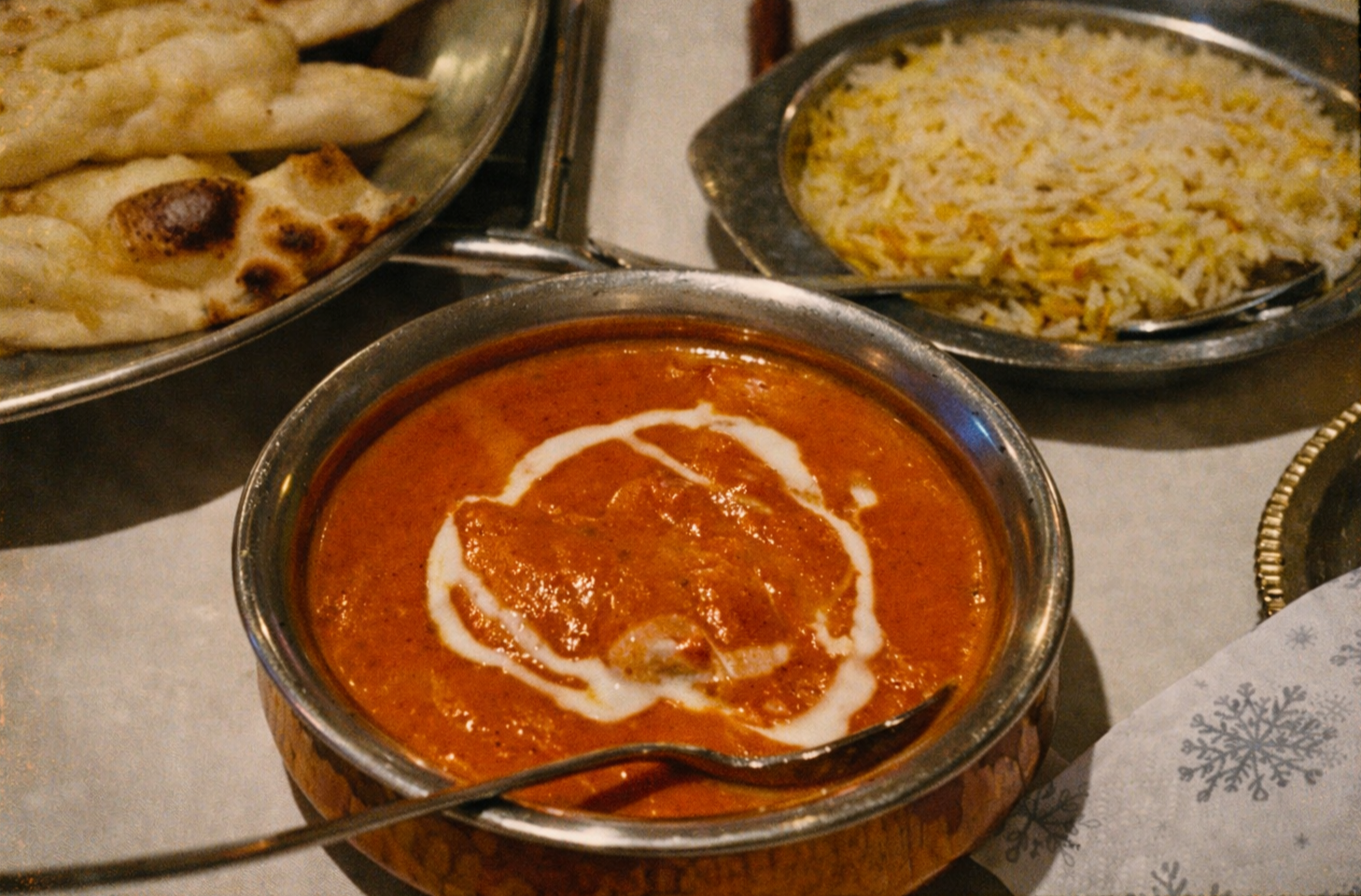
My dishes arrive the colour of deeply fired terracotta, a swirl of clean mint yoghurt decorating the centre of the karahi, hinting at a cooling freshness I hope I won’t desperately need. The spices burst forward, lifting me off the edge of my seat in anticipation: cumin, coriander, turmeric, garam masala, paprika, ginger, garlic — each fighting for centre stage in a riot of aroma, crashing together in perfect harmony like the cacophony of the rainforest canopy at sunrise.
I rise from my seat, allowing the physical temptation to wash over me. Arming myself I stab forward, digging into the glowing pile of otherworldly treasures at my fingertips — all mine. Like Gollum, I hoard this precious bounty for myself. No sharing here. Not at this table.
The pilau rice takes me by surprise, the real standout, the real star of the show. I dump a portion onto my plate, kicking and screaming with aniseed and fennel, graced with a dazzling saffron hue — none of those dyed grains here, no green and red specks cluttering sterile white rice. This is the proper stuff.
The curry is perfectly spiced — thank the gods, whichever you prefer, but I’m hedging my bets — the zing of chilli waking my senses and warming my palate. But all too soon, I’m full to the brim. My earlier all-out attack on the river of free chocolate coming back to haunt me. I wish I could continue, but I know I am defeated.
How professional eaters do what they do, I have no idea, though like everyone else I’m convinced I could give it a good old go while watching safely from behind a screen. Still, I’ve eaten enough of this beloved dish to be reminded why it occupies such a lofty position in the hearts and minds of the British nation. It’s fantastic — no doubt.
The famous chicken Tikka-Masala hits all the banging and crashing notes of spice and flavour you want from a curry without tipping over into the sort of unhinged aggression that takes your head in its hands and bashes it against the table in a fit of savage attention seeking. I’m looking at you, Jalfrezi.
Is it my new favourite? No, and that’s the honest truth. I’ll continue my habit of random, ever-changing orders at my local until I hit upon a real winner. But by God, this has been a great meal. The rest will come home with me, and I’ll make sure it doesn’t go to waste. In fact, it doesn’t even last the night — I devour the leftovers the moment I walk through my front door.
--------------------------------------
The prospect of my journey home is daunting: two and a half hours and 122 miles—a scary thought, for I am not American or Australian and distances mean something very different here. Two and a half hours to our colonial cousins is just down the road, a distance you might travel for particularly tasty bagels or to catch up with a friend; for us, it is a cross-country trek worthy of special planning and provisioning. But home is where I want to be, so I brave the cold, dark roads ahead, drawn like a moth to the warm glow of my loved one and the comfort of familiarity borne of my birthplace.
My travels today have taught me a great deal about this unfairly under-visited corner of the United Kingdoms: the West Midlands, West Mercia, the Black Country. A region steeped in deep-rooted pride for its rich manufacturing heritage — a history of making and creating; a place of birth and rebirth. My chosen stops by no means encompass the full range of experiences available to those who venture into these rolling rural hills and sprawling, post-industrial heartlands that have grown among them over the centuries. But they have given me a snapshot of what the people here have to be so immensely proud of: a humble, self-assuredness in everything this forgotten kingdom has given to the world.
Stratford gave me perspective on a national hero who helped give birth to modern British literary culture and shaped the language we take for granted today. I thought I knew him well, but I know him far better now, having retraced just a few of his footsteps through the town that shaped the man he became.
Bournville imbued me with a deeper understanding of the journey it took to bring life to one of the world’s small pleasures, and of the men who endeavoured to think and feel differently—to strive for a better world for the many rather than one which benefited only the few. Every block of Dairy Milk will taste that little bit sweeter now that I know something of what goes into it, a hint of how it came to be, and the people who care so deeply about making it.
Coventry’s story of new life rising from the ashes of destruction will forever inspire me. What was once a crumbling ruin in the aftermath of the darkest nights in British history now a beacon of what can be—UK City of Culture 2021, no less. Who would have thought it could rise to such a station from the rumbling centre of industry that once made it such a tempting target for its enemies? Coventry refuses to shy away from its past. Old St Michael’s stands as testament to that, as does its twinning with Dresden and Volgograd – formerly Stalingrad —three cities devastated by the power of war, bound together in a shared commitment to peace, forgiveness, and the hope of a better future. I think we could all learn something from this city.
And finally, Tamworth: the forgotten capital of a forgotten kingdom that birthed the nation I am trying to better understand today. I didn’t realise it at the time, but my short stay here would teach me more about this country than I could have imagined in the days before my journey. Not only the birthplace of a nation, but emblematic of its rebirth into a mosaic of cultures and intertwining traditions that shape the society we live in today — for better, and sometimes for more complicated. Still, I choose to focus on the positives and I wish for you all to come along with me as I continue to seek them out.
January: deepest, darkest winter, yet the start of a new year brimming with possibility. I have taken the first steps in my journey of exploration and could not be happier with what I have found so far. A day of learning and inner discovery I had not expected, but that’s to be expected I expect. And so now I stand on the precipice of my next adventure; the Dales, the Moors, the Ridings. What will I discover in God’s Own Country? Yorkshire beckons.
