Chapter One. (Part Three.)
West Midlands.
Birth & Rebirth.
Coventry.
The burnt orange glow of the setting sun behind me ignites the bare winter branches of the trees which flank my journey. The branches burn brightly in the dimming light of the sky, red and orange the main palette, tinged at the edges with a deep purple running into blue. The trees lining the route of my pilgrimage burn with a sacred fire that flashes back at me, reflected in every clump of fading snow. The road takes me on due east into the coming night, the light fading faster than I could have imagined. I’m chasing a deadline I know I will never make, but the final goal of my journey is one I cannot strike off today’s itinerary, its place in my plans too great to erase.
The great asphalt arteries disgorge me from their flow and onto the crazy jumble of intertwining ring roads and junctions which encircle the old town centre of Coventry, though the term ‘old town’ can hardly seem fitting in this setting. Unlike the Old Town of Warsaw, rebuilt in painstaking architectural memory after its obliteration during the Second World War, or the similar fate of Ypres following its bombardment during the First, Coventry has been rebuilt in the image of post-war modernism. For the most part, remnants of its pre-war streets are few and far between.
My dance up and down slip road after slip road, spaced in most cases a handful of metres apart — you would have thought a replanned city might have been designed more efficiently — has me dog-fighting my fellow motorists to gain my place in the stream of motion, everyone out for themselves, fighting for their own goals and interests. A dinged-up red Corsa swoops into my peripheral vision, looming into the sights of my wing mirror and presenting me with a particularly determined adversary. Nudging my way out of the diminishing safety of my slip road and into the ring road, we engage in a perilous game of chicken, each combatant speeding up and slowing down as our ambitions repel one another.
The road ahead begins to dip into a tunnel, the concrete wall in front of me becoming more and more real with every passing second, and I admit defeat. This tosser can have his little victory and I’ll drive off into a life better spent, cursing him through my windscreen, questioning his sanity and his moral faculties in equal measure.
My destination rises between modern buildings, seen in a flash between tower blocks and concrete Brutalist structures as I turn this way and that in the inner-city maze. Up dead-end roads and down one-way systems I turn, in desperate search of somewhere to park and venture forward on the final steps of my pilgrimage. The famous twin spires of the Cathedral of St Michael — Old St Michael’s — and its brother holding stoic court above Trinity Church across the lawned courtyard: the surviving siblings in the ‘City of Three Spires’, one whole, one ruined, one lost forevermore.
I finally find a spot in a multi-storey car park, cold and concrete. Zipping up my jacket and stuffing my hands deep in my pockets, I stride out determined against the evening chill, what little warmth of the day long gone now, the temperature sinking with the sun in the west.
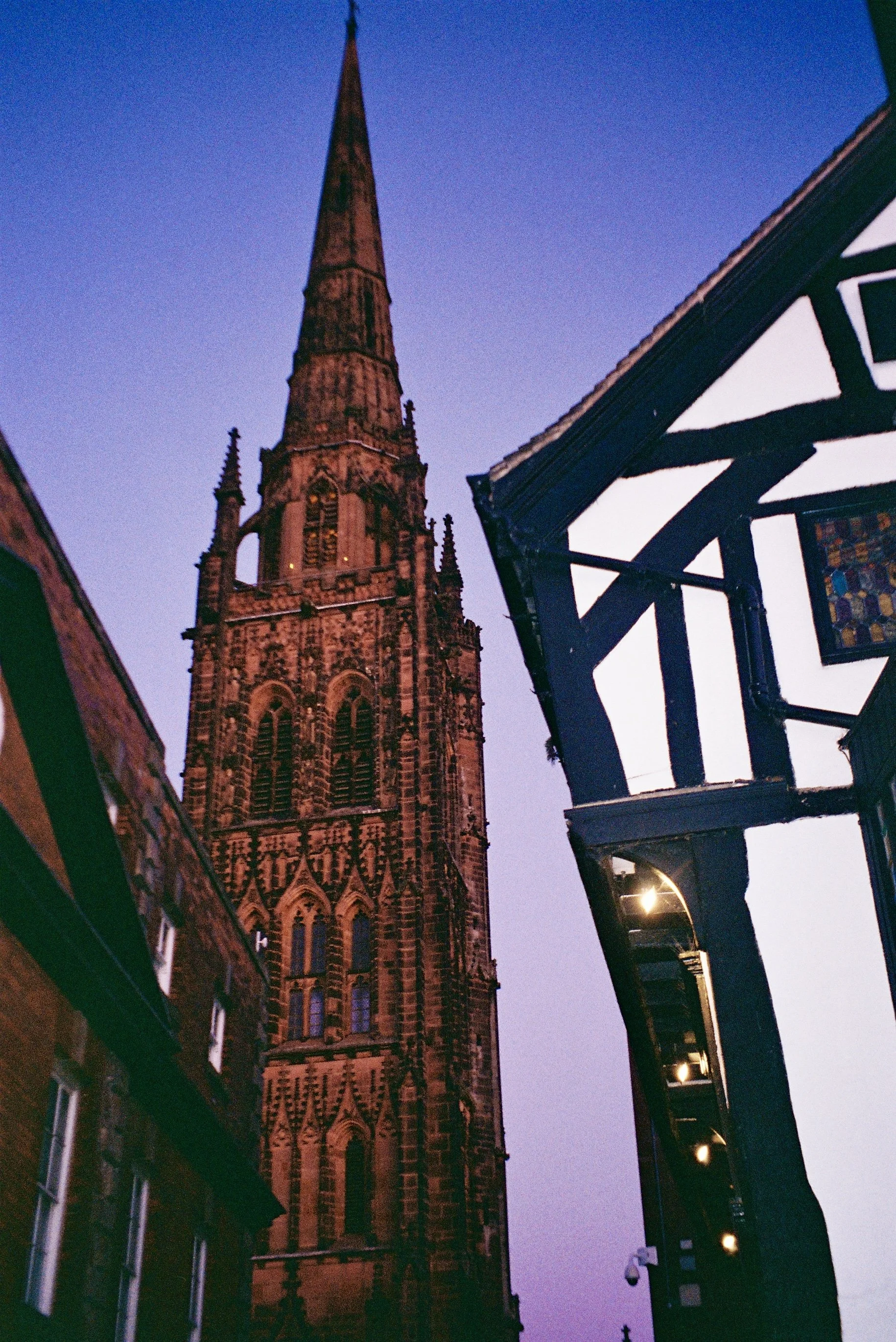
Through the bustling shopping district, I ask directions from a friendly traffic warden — a rare breed — who points me the right way, across the pedestrian square at the beating heart of modern Coventry city centre, passing under the statue of Lady Godiva — more now than just a lyric in a Queen anthem — riding naked still through her city one thousand years after her act of protest against her husband’s oppressive taxation of the common man. Left I turn down old Pepper Lane, its medieval timber-framed buildings almost all that remain of Old Coventry, the spire of Old St Michael’s like a needle piercing the empty sky at the alley’s end.
Out of the cobbled lane, where the wind funnels through to whip savagely at my exposed ears, I’m deposited into the open space beyond, the wind suddenly deathly quiet. St Michael’s Fields, green and ringed with oak, ash, and lime trees, feels like a world apart from the energy and activity happening all around. This is undoubtedly a spot for reflection, a place of peace where each visitor is urged to be present and mindful in the presence of a poignant testament to one of the darkest chapters in world history — the history of this country, and this city in particular.
Walking forward down the path, salt grit grinding against the asphalt beneath my feet, I’m enveloped by the shadow of the spire rising above me, its red-brick gargoyles leaning out into the world with snapping jaws and snarling faces, protecting the structure from the evil spirits who sought its destruction. The gates are barred against my entry; I knew they would be. I’ve missed the closing time of the church and its accompanying museum by a good hour, and must content myself with peeking through the gaps at the scene beyond, unable to truly experience the atmosphere within the Old Cathedral’s battered walls.
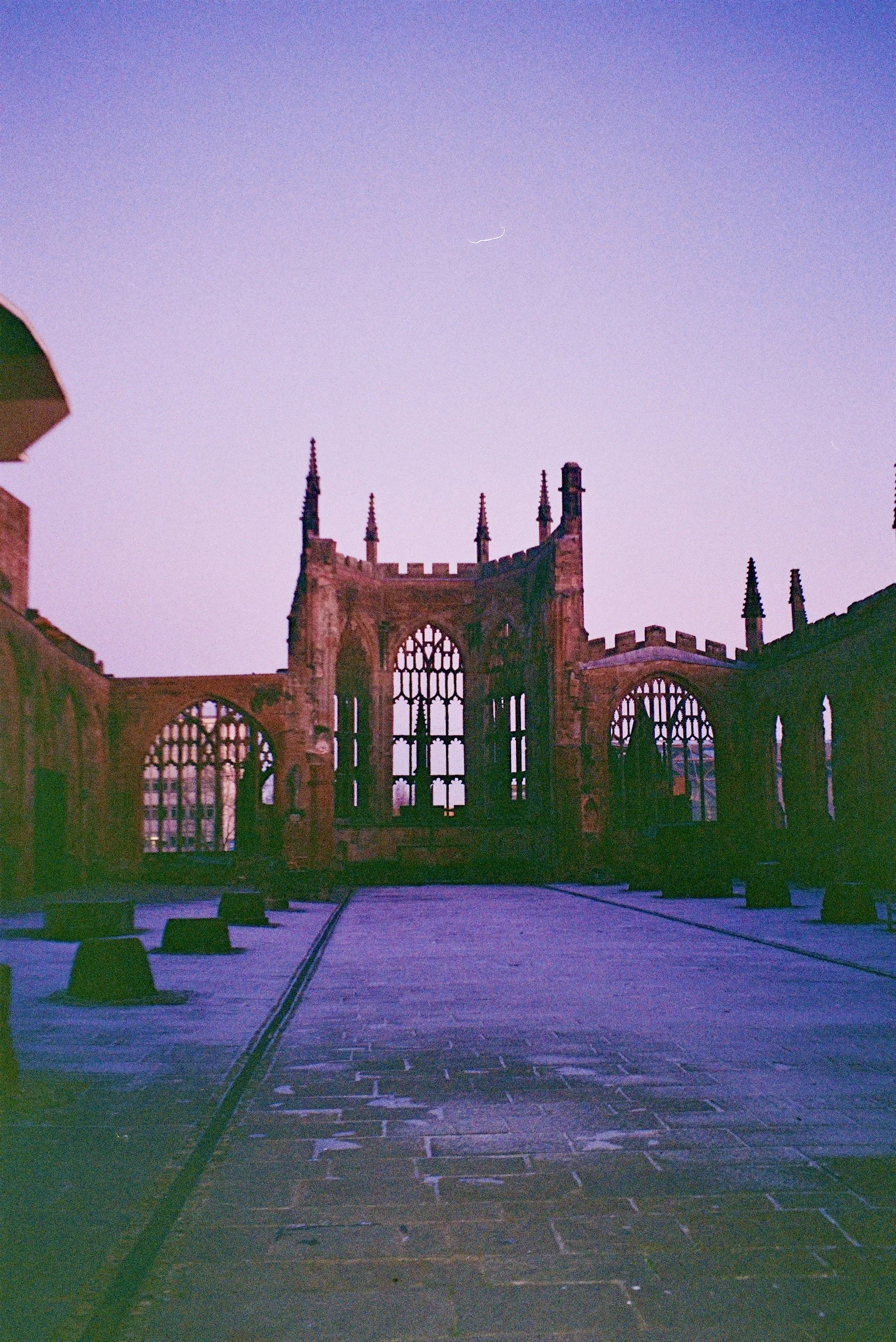
The roof is long gone, leaving the flagstones open to the power of the elements sent forth from heaven, the shattered skeletal walls of its structure all that remain now. Snow and ice carpet the floor on the path down to the altar, the columns which once held the roof aloft now broken down to their feet, flanking the aisle. Where once petals and confetti would have coated the passage of newly-wed couples linked arm in arm, now crumbled masonry and ice take their place.
British history remembers the nights when the enemy flew overhead and air-raid sirens rang out their alarm call, sending the blackout nights into panicked chaos. Between September 1940 and May 1941, nine months of terror reigned as the towns and cities of Great Britain fell under what must have felt like constant bombardment by the aerial forces of Hitler’s Luftwaffe and their Blitzkrieg — ‘Lightning War’. Old St Michael’s remains in its ruined state here on home soil, just as those villages détruits dot the thousand-kilometre path of destruction laid along the Western Front bitterly contested only twenty years earlier, the memory of the First World War — the Great War, the “war to end all wars” — still firmly alive for so many forced to suffer again.
Coventry has always been a home of manufacturing. In the words of J. B. Priestley, who visited the city seven years prior to its destruction as part of English Journey in the autumn of 1933:
“In the thirteenth century it was making cutlery: in the fourteenth, cloth; in the fifteenth, gloves; in the sixteenth, buttons; in the seventeenth, clocks; in the eighteenth, ribbons; in the nineteenth, sewing machines and bicycles; and now, in the twentieth, motor cars, electrical gadgets, machine tools, and wireless apparatus”.
Only six years later, that manufacturing heritage would position Coventry as a major centre of wartime industry, producing munitions, metalwork, automobiles, and aeroplane engines — the city responsible for the production of a quarter of all British aircraft during the war — making it one of the Third Reich’s most important targets during the height of the Blitz.
As a medieval city reforged during the Industrial Revolution, much of the workforce lived in back-to-back housing interwoven with the factories the Luftwaffe set their sights upon. The homes of the working class, packed tight among the city’s industry, created the perfect storm for destruction — a primed tinderbox against which the Germans struck their match.
On November 14th, 1940, 515 German bombers descended from the skies and battered the city with the unreal power of modern warfare. As part of Unternehmen Mondscheinsonate — Operation Moonlight Sonata — pilots flying Heinkel He 111s dropped 500 tonnes of high explosives and 36,000 incendiary bombs during an unrelenting ten-hour raid. Each aircraft delivered its payload before returning to bases in France to reload, while the men of the 95th Heavy Anti-Aircraft Regiment, Royal Artillery, fired blindly back into the skies, downing just one bomber for their 6,700 rounds.
In that single winter night, 4,300 homes were laid to waste; a third of the city’s factories were destroyed, the rest damaged, none left untouched. Two-thirds of Coventry suffered what was described as ‘severe damage’, with almost 1,400 people killed — the exact number never confirmed — and many more badly injured.
The destruction was so complete that Joseph Goebbels coined the term Koventrieren — “to Coventrate” — meaning to annihilate or reduce to rubble — a fate the British armed forces and Churchill were motivated to reproduce on a grand scale. Only a month later Operation Abigail Rachel targeted the German industrial city of Mannheim with a firebombing raid inspired by the Luftwaffe’s success in carpet bombing Coventry, London, Liverpool and Glasgow - alongside so many other integral port towns and industrial centres throughout the land. The German administration described the attack as “insignificant”, but it spelled a change in mission direction for the RAF and High Command, away from imprecise targeted bombing raids against German military targets and towards the widespread firebombing of German cities — most devastatingly the destruction of Coventry’s twin city, Dresden, in the closing stages of the war.
Standing here now, in the ominous presence of such destruction, I am forced to believe there are truly no winning sides in war.
St Michael’s Cathedral was hit early on in the raid, an incendiary bomb smashing through its ceiling, but the resulting fire was quickly brought under control by the volunteer firefighting crews attempting to stem the wave of devastation rapidly overtaking the centre of the city. It would become clear to all by the rising of the sun on the 15th of November that the brave efforts of those everyday but extraordinary people of Coventry would be in vain, as the Cathedral went on to be hit by a further barrage of bombs and incendiary devices, reducing it to the ruin of its former glory which stands as testament to the horrors of the Blitz today.
The efforts of the Nazi Luftwaffe laid the flagstones bare to the elements — the ghost of its former grandeur more striking to me now than I’m sure it could ever have been. Where its destruction was the result of the actions of foreign enemies, the efforts of Henry VIII — monarch and ‘Protector of the Faith’ — spelt destruction for the city’s third spire, Christ’s Church in Greyfriars. Henry’s Reformation and the subsequent Dissolution of the Monasteries in the sixteenth century brought about the razing of Christ’s Church, in an area of Coventry that still today clings to the name of the ‘Grey Friars’ of the Franciscan friary who were custodians of the lost spire.
A new church was built in the nineteenth century in the spectral shadow of the old friary, its construction funded by the profits of Coventry’s industrialisation. This same industrialisation made the city such an attractive target for Hermann Göring’s Luftwaffe strategists, whose bombing campaign in the closing stages of the Blitz ultimately led to its destruction — another victim of the fires of war.
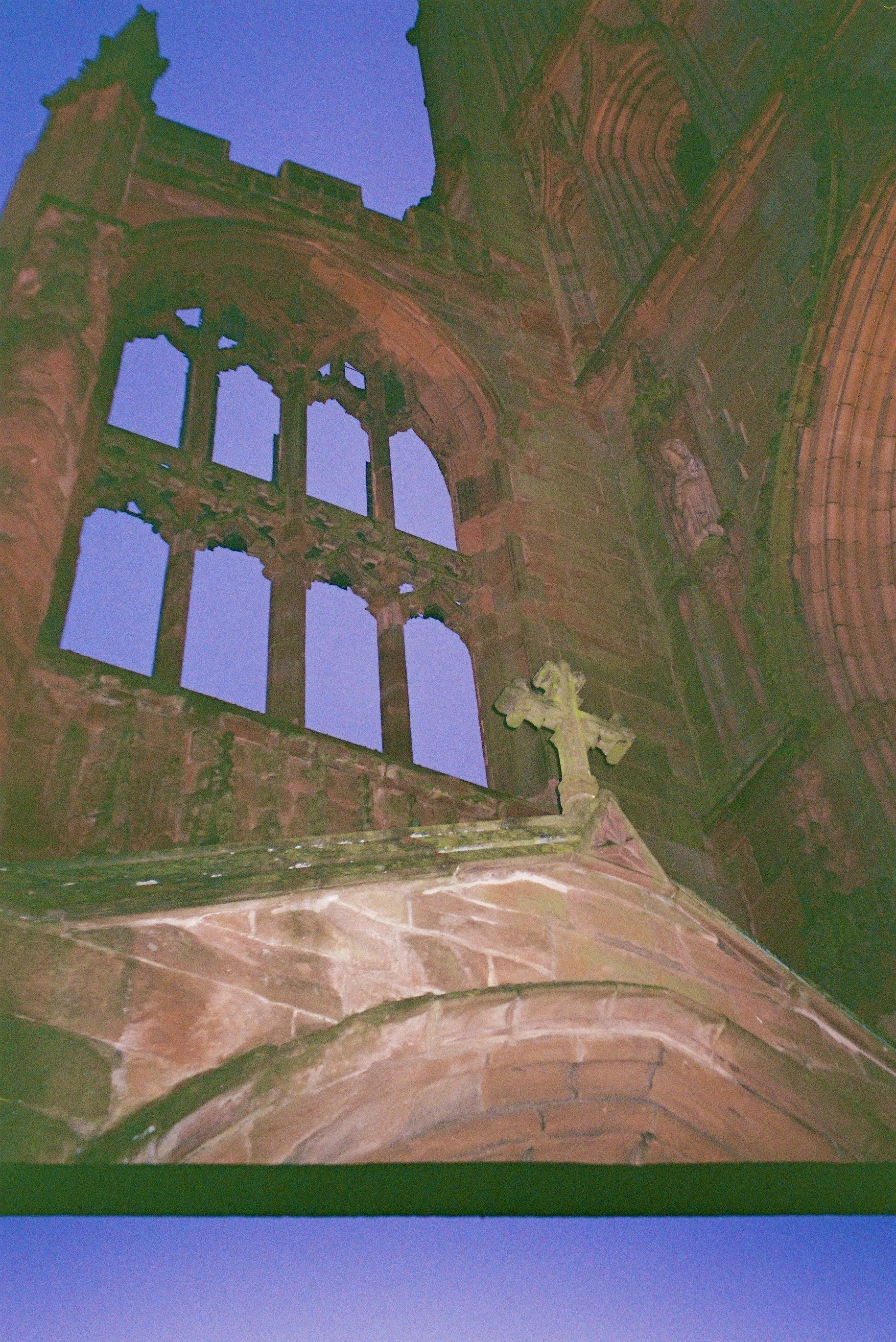
Stepping back from the gates, I look up to take in the shrapnel-gouged remains and I’m struck by a remnant that feels alien to my past experiences of ruins the world over. Broken glass. It’s so trivial, such a small detail, but one that cuts deep into my conscience. It’s something I’ve never considered when visiting abandoned abbeys or great amphitheatres: something that makes the ruin before me feel so much realer, the openings in the vaulted windows not worn smooth by time but still sharp with painful memory. The shards prick out from their housings as a poignant reminder of beauty lost within living memory, and of the stories this stained glass and these broken walls once told.
In the shadow of these ruins of war, I find myself asking whether this could all have been stopped — prevented — the wave of devastation bottled up and snuffed out. When it comes to the outbreak of the Second World War, that is a question far larger than I feel qualified to answer, no matter how many pages I’m offered, though I have my suspicions and theories. The question of Coventry’s destruction, however — that November night whose results are scarred into the very fabric of this city — is more nuanced. A question of myth and legend.
To approach it, we must turn south-east and follow the M1 artery to the outskirts of Milton Keynes — a city that did not yet exist — and to the grounds of Bletchley Park, where the Government Code and Cypher School laboured at the unenviable task of cracking the supposedly unbreakable secrets of Nazi communications: the Enigma code. Headed by the genius of Alan Turing — the mind that helped birth the modern computer — and his team, these analysts achieved the unthinkable, cracking the uncrackable and weaponising the Nazis’ cultish devotion to ritual, exploiting predictable phrases such as Heil Hitler to identify patterns in encrypted messages.
All very technical, and I haven’t the foggiest idea how it was truly done — but it was done, and it proved a decisive victory in the information war. The legend — advanced by a senior RAF officer — claims that the British high command was aware of the planned bombing of Coventry but, in order to protect the secret that Enigma had been broken, allowed the attack to proceed. Those in charge were faced with a brutal ethical dilemma: whether or not to sacrifice the lives of those in Coventry for the greater good of the countless lives saved by maintaining the deception. Whether or not this story is true, the attack went ahead, and its consequences must have lived on in the consciences of all involved evermore.
I wish I could have arrived earlier, I muse, as I glimpse the stairs down to the Blitz Museum in the bowels of the ruined Cathedral through another locked gate on the building’s flank. I trudge downhill over the ancient cobbles of Bayley Lane, between Old St Michael’s and the equally medieval Guildhall of St Mary’s, which survived the efforts of the Nazi bombers relatively unscathed, despite being just spitting distance from the fires that raged opposite.
Thank God — or perhaps more fittingly, thank the firefighters who battled countless blazes throughout the night while bombs fell around them — for it is beautiful within, housing stunning stained-glass windows reminiscent of what must once have existed in its neighbour before they were blown out and scattered to the wind. Out again I step from this ancient lane into a modernist landscape beyond: the Herbert Art Gallery and Museum ahead, its curved glass roof bent like a great wave crashing away from me, and the New Cathedral growing from the side of the Old.
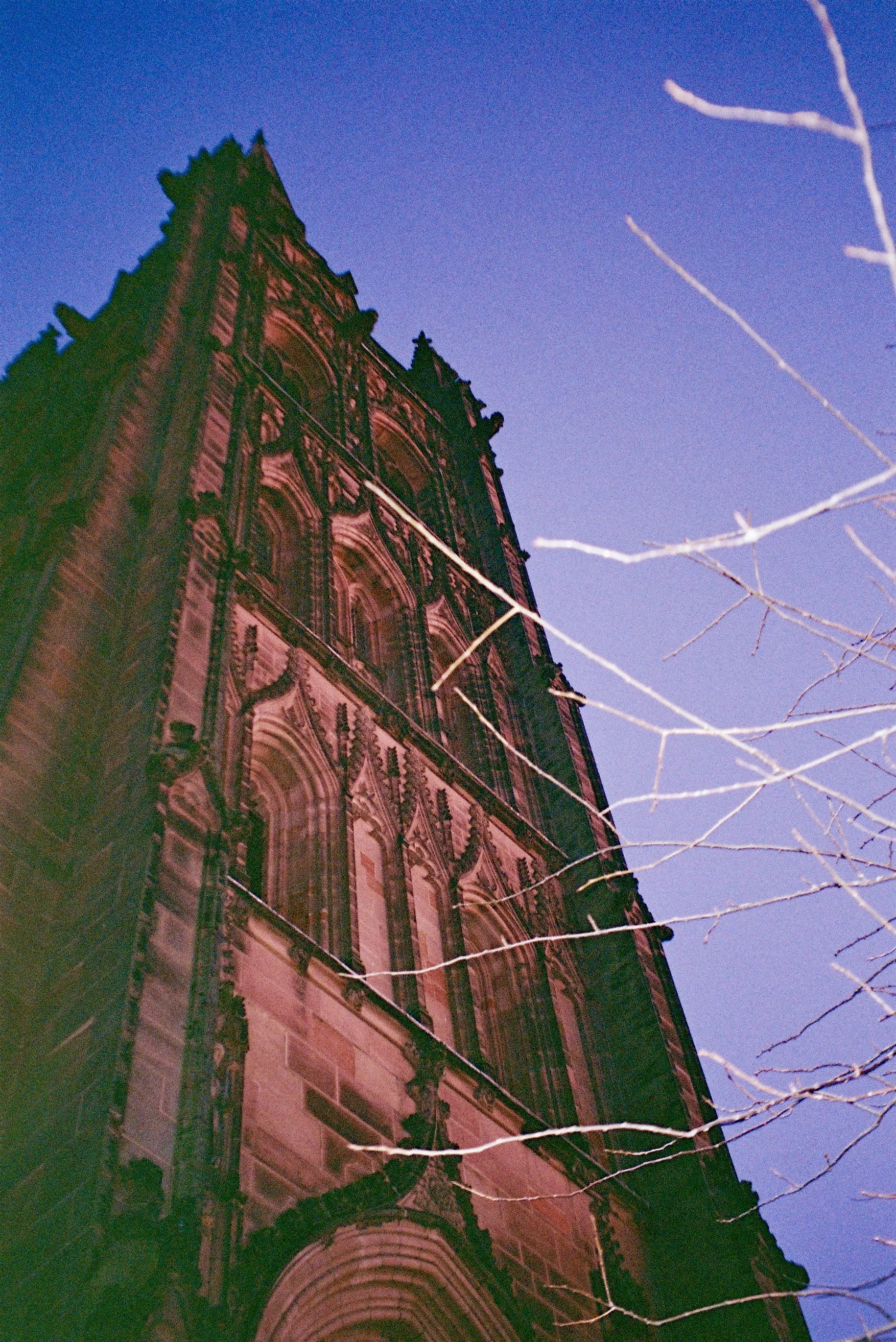
The New Cathedral embodies the post-war spirit: new birth from old wounds, its structure rising — born again like a phoenix — in red and pinkish stone from the ashes and rubble of its predecessor. Though built from the same Hollington sandstone as St Michael’s, its modernist architecture stands in stark contrast to the grand Gothic structure it accompanies. Replaced does not feel like the right word. Perhaps relieved is closer: the New Cathedral lifting the weight of spiritual responsibility from the Old’s broken shoulders.
This radical and inspiring departure from Gothic tradition was intended as a statement of rebirth by its architect, Basil Spence, a statement echoed — with wildly varying degrees of success — across post-war Britain. Many cities were scarred by modernist rebuilding, losing character and charm beneath landslides of concrete and steel. Yet here, in Coventry, I find myself moved by the stark and deliberate juxtaposition of Old and New.
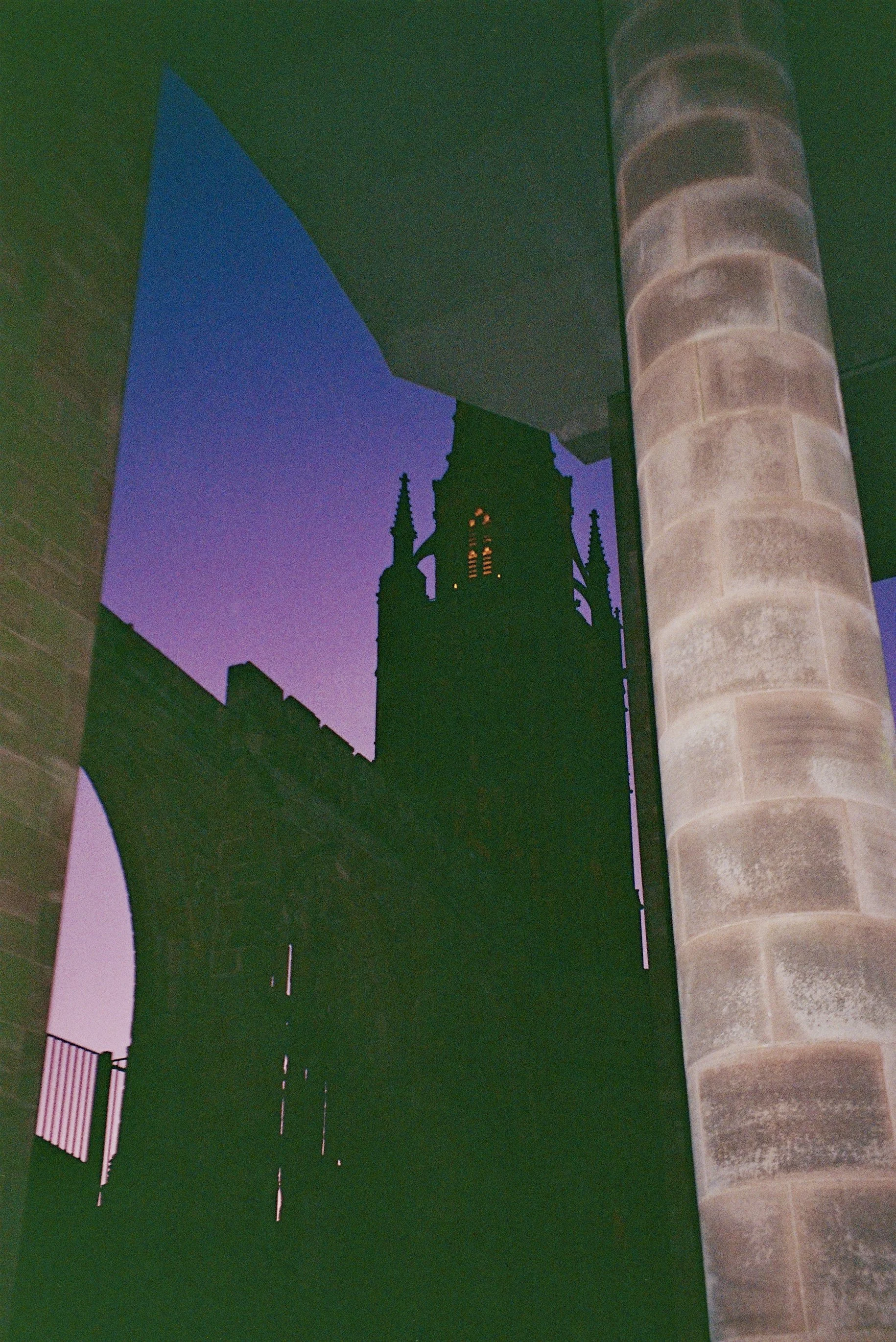
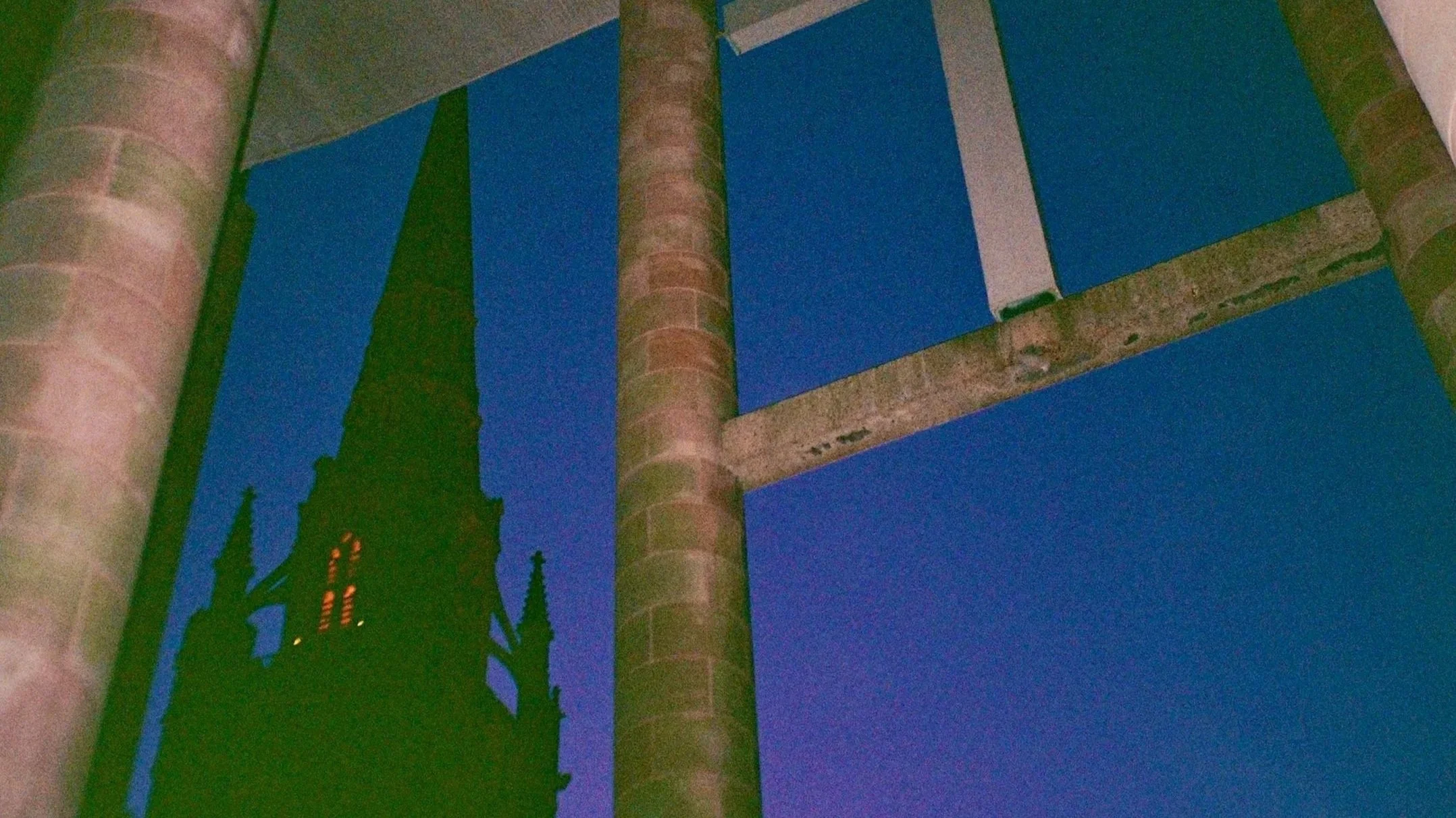
I wander up the stairs and under the towering arch that connects the two great structures and spans the gap in centuries. I stop to stand a moment in rapt wonder as the old spire is framed by massive Hollington stone pillars, the purple sky of the day’s last light tinged with the deep blue of oncoming night, forming the perfect backdrop for my moment of contemplation. The thoughts and feelings evoked by this place wash over me in a moment of moving clarity, clearing my mind of all other worldly worries, which pale in comparison to the hardships and horrors faced by those at home and abroad during those dark days of human history.
As children, we are taught about the days of the Blitz. We are taken to air-raid shelters and put into gas masks to simulate the terror our grandparents must have felt when those sirens began to wail. We’re told about the evacuation of children from the cities and wonder how we might have dealt with that journey, hoping we would have ended up in a grand stately home like the Pevensie children in The Lion, the Witch and the Wardrobe, rather than finding ourselves in a situation like poor young William at the start of Goodnight Mister Tom.
But we are very rarely — if ever — told the story from the other side: the side of our enemies, whose children suffered much the same fate. Over half a million civilians perished on both sides during the bombing raids on Allied and German cities. I can’t help but stand here believing, deep down, that we must surely have learned from the lessons of the past. But I know we haven’t. I know these horrors continue, and that the people of Gaza face a fate just as unimaginable almost a century later. When will we learn, and how can we take those lessons and create a better world community for everyone? A question far larger than I feel capable or qualified to answer — but one I must ask nonetheless.
Hooded figures roam the grounds around me in the growing darkness, the grounds of both churches — all three churches? — suddenly crawling with lost spirits, like the ghosts of clergymen wandering these paths on endless ministry. But these figures are no phantom holy men. They linger in the shadows, counting money in the secrecy of huddled groups — some might argue this is the very crime Henry VIII dissolved the monasteries for, though I assume these men are not so prone to acts of ecclesiastical revelation, community spiritedness, or jolly merriment.
After dark, these sacred grounds no longer feel like places of contemplation, rumination, revelation, and salvation; they feel threatening and uncomfortable. I hope — perhaps the naïve romantic in me taking control — that I can sense the Fields’ desire to right that atmosphere, rising from the soil beneath my feet, soil enriched by the ashes of lives lost, ready to nourish the growth of new life, new energy.
I turn away from Trinity Church and back towards Pepper Lane. I don’t want to sully my experience here by opening myself up to the potential malign intentions of others. My city senses tingle at the looks I gather from the groups around me — probably nothing more than questioning glances at a stranger taking notes and pictures in the dark — but I’m not willing to linger long enough to prove that assumption right or wrong. Besides, it’s dark, it’s cold, it’s been a long day, and I’m beginning to feel that dull ache in the pit of my stomach that precedes its rumbling anguish at a general lack of meaningful sustenance.
So, time to get on — back in time towards the ancient seat of power in these lands of West Mercia.
