Chapter One. (Part Two.)
West Midlands.
Birth & Rebirth.
Bournville.
Hopping back into my car, I join a mass of midday drivers as I pull out of the medieval town centre and crawl into the modern commercial sprawl of nightmares that has sprung up on the outskirts of this gorgeous old gingerbread town. The quaint character of Shakespeare’s Stratford here replaced by corrugated iron, concrete, car dealerships, and retail parks. The soft white snow, now muddied, squelches into piles of slush churned up by a never-ending procession of automobiles — a procession I now find myself stuck in, the motor turning over at a standstill, waiting to join the Birmingham Road out of Stratford and deeper towards England’s second city.
Finally, leaving the outer orbit of the Bard’s town behind me, I am eased back into the peace and quiet of England’s countryside. Rolling over undulating hills and through spacious fields between bristling hedgerows, all sparkling in the midday sun, my journey through this fairytale landscape is sweetened all the more by the scattered appearance of idyllic little gumdrop villages. The roofs are dusted with icing sugar; the thatched cottages and wood-beamed pubs unchanged in generations. Out of my driver’s side window, across a neatly trimmed lawn, a sprawling country manor stands bold and strong in governance of the surrounding landscape. Faced in dull white Kingsthorpe stone, a babbling brook cuts through its grounds and crashes over a tumbling weir, its contents falling in cascading, twinkling waterfalls and rushing on beneath the stone bridge under my flying wheels.
I catch this in a flash as I motor on through. In times of old I would have pulled up the reins of my horse, stopped in at that country home for supper, or for a pint in the warmth of the hostelry. But before I know it, I’m round the bend and out of the village. I look up to catch a last glimpse of this lost-in-time staging post, yearning already to turn back, but I’m in a rush to get on. Looking back down at the twisting road ahead, I flick my eyes up and double-take the rear-view mirror as I register a flash of high-visibility in the otherwise natural vista. Crap—the rozzers. I check the speed of my steed. I’m okay, I think.
The fields give way to fences, the thatched picket cottages to rows of tenements, and I know the countryside is fading away in my mirrors. There are no longer acres between named settlements; instead they are interwoven, one rolling into another, back-to-back and indistinguishable. West Heath. Hawkesley. Kings Norton. Towns that have no meaning to me, no defining features—just names on a map, buildings on the ground.
And then it all changes.
A unique character emerges from these rows of monotony. The shades and hues shift from brown and grey to rich red brick: still tenements, but with a strength of identity undeniable to transient passer-by and permanent resident alike. I know from the street names and shopfront fascia boards that I have entered Bournville — home of Cadbury for over 150 years. My next destination lies “straight ahead”, say the purple signposts, and I dutifully follow, sniffing the air like a thirsty bloodhound in search of my favourite treat.
“Right here.”
I swing the wheel and rattle past the towering Romanesque basilica of the Bournville Parish Church on the corner of the factory grounds, the purple gates swung open, inviting in the dutiful congregation to the one true Lord: chocolate. To my right, a stunning fairytale pavilion — air-lifted straight out of the Alpine heartlands of the master chocolatiers — spectates over a ragged game of football being played by a group of children in the packed snow, layered upon layer covering the factory’s playing fields.
I park up among a sea of family wagons in the overflow car park right at the back of the humming factory. I seem to have misjudged the timing of my visit. I thought the schools would all be back — it being the first Monday of the year and the rest of us, myself excepted of course, firmly returned to the swing of normal life. But no. The river of screaming children flowing towards the entrance, parents trudging along in tow, suggests otherwise.
I suddenly begin to feel debilitatingly self-conscious of my presence here. The families ahead of me in the queue bubble over with excitement for what lies beyond the closed purple doors; I, in comparison, shuffle from foot to foot, my eyes like spotlights scanning the room, searching for a like-minded grown-up child. I find none.
Sidling up to the attendant, I give a hushed “Just the one” and smile awkwardly as she looks me up and down with a tight-lipped smile, seemingly reserving her excitably performative pip for the younger guests. “Your chocolate,” she says, reaching down without taking her eyes off me, making no secret of the judgement she has already come to — or maybe I’m just imagining it.
She pops a selected handful of some of the millions of chocolate bars Bournville produces each week into my outstretched palm. A fantastic selection, if I do say so myself — almost my perfect trio: a Wispa, a Dairy Milk Caramel, and that bastion of confectionery, a classic Dairy Milk. Joy. Pure joy. Who would’ve thought it: free chocolate before I even get through the door, my spirits positively soar. If this is what’s in store, I’m in luck. I’ll come out the same way as Augustus Gloop — covered head to toe, licking my hands, lips, arms, and elbows.
Gripping my cache and skipping through the purple doors into the wonderful world of Wonka — Cadbury — beyond, I find myself not where I thought I might be. There are no machines puffing purple smoke and dispensing chocolate button after chocolate button onto a rolling conveyor belt. Instead, I’m walking through a rainforest, the chirping call of parrots and howler monkeys replacing the churn and clunk of machinery.
Stride on, great explorer.
Like Wonka, I half-expect to find little orange men dancing around the corner in the jungle bushes — but no. Instead, I’m met face-to-face with the thrusting silver breastplate of a moustached conquistador: Hernán Cortés himself — sword sheathed, for once in his life — standing hauntingly over a troop of Aztec villagers.
The ‘great’ man before me pillaged these jungles — well, not these jungles; I am in Birmingham after all — for all they were worth, stripping them of gold and jewels enough to restock the Spanish royal coffers to Smaugish levels. The lost city of Eldorado may still hold its gold somewhere deep in the Amazon, but who was to know that another treasure brought back to Europe in 1528 would go on to drown that dowery many times over?
Not chests of gold, but sacks of beans — small, round, and looking enough like sheep’s dung to be flung overboard by pirates and privateers who sacked Spanish galleons on their journeys home. Chocolate was the real treasure. The real money-maker.
The Aztecs knew the cocoa tree’s secrets: how to draw flavour from its beans and enrich spiritual life with its spice. They shared this knowledge with the conquistadors and — unlike so much of Aztec and Mayan culture, which was wiped comprehensively from the face of the earth — it survived. The Conquistadors ran back to the court of Charles I with their new discovery which the King and his successors kept all for themselves maintaining its secret for almost a century
Sugar replaced the Aztec chilli - cinnamon, vanilla, and nutmeg softening the bitterness — as drinking chocolate became a luxury of the Spanish royal courts. But when Princess Anne of Austria – Charles I’s great-granddaughter – was married off to King Louis XIII of France, she carried the taste with her to his court at the Louvre Palace, soon the secret was out and Europe fell in love.
From here, drinking chocolate spread like wildfire through the upper classes. The first ‘Chocolate House’ opened on Queen’s Head Alley in Bishopsgate, London in 1657, selling the new “West Indian drink” to wealthy patrons who simply couldn’t get enough.
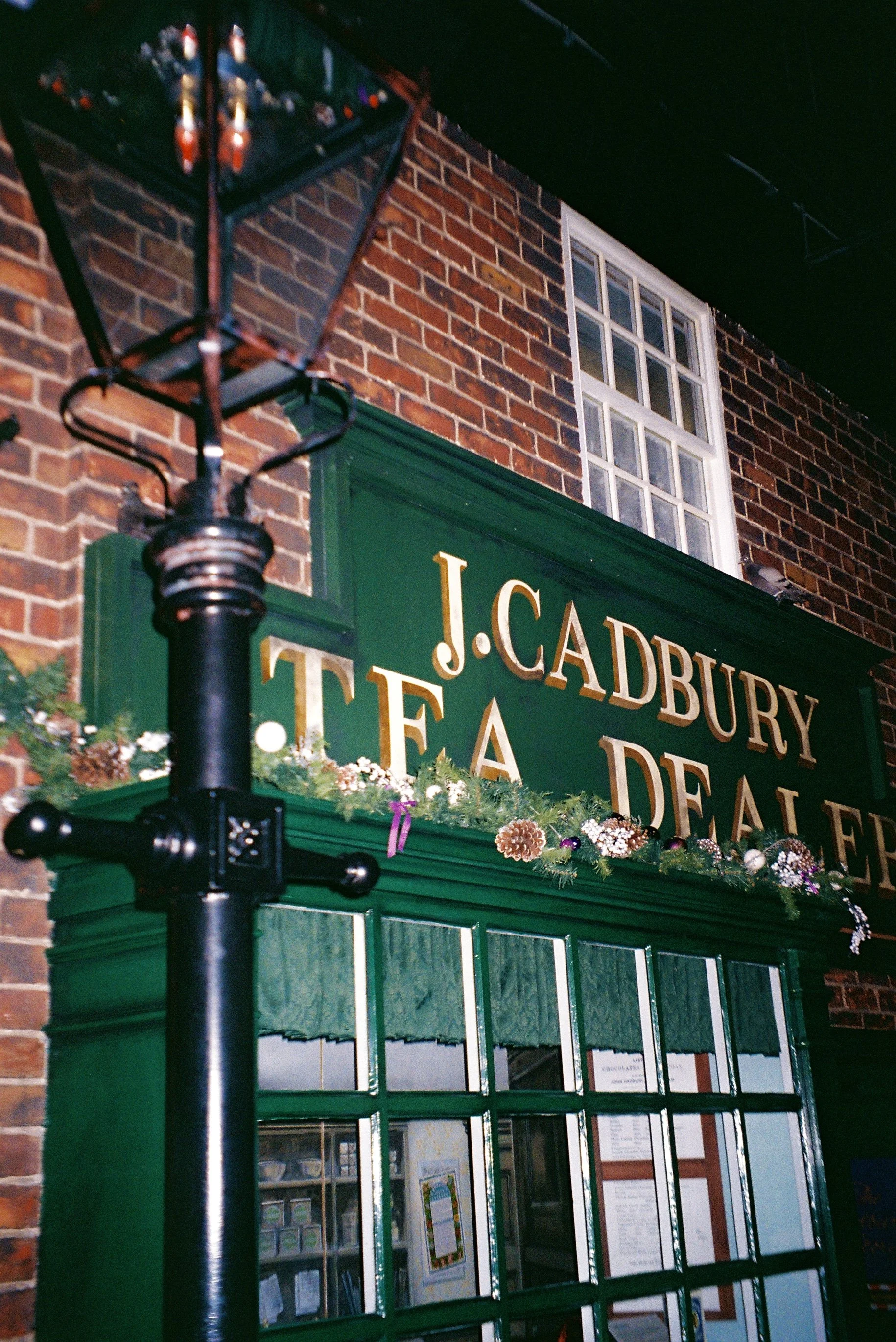
This is the story of how the exotic drink of Europe’s luxurious elite arrived at No. 93 Bull Street, Birmingham, the very spot where, in 1824, the enterprising John Cadbury opened his first shop selling tea, coffee, and drinking chocolate to the people of England’s second city, wrapped in the throes of an unimaginable Industrial Revolution and the economic explosion with which it went hand in hand. John Cadbury’s enterprising nature was funnelled into the trade industry as his only means of professional progression, for Mr Cadbury was a Quaker — a “peculiar sect of spiritual people,” as they were seen by his contemporaries. Quakers could neither attend universities nor join the military — as pacifists — so the only profession open to them was trade, and they were mightily successful at it too. Tea, coffee, and drinking chocolate were viewed as acceptable alternatives to alcohol, which their beliefs strongly condemned on the sound grounds that it impaired judgement and affected health — well ahead of their time — and so, in seeing a gap in the market, John set out on the road to greatness with his feet in the exotic produce pouring in from Britain’s burgeoning maritime empire.
In 1854, Cadbury’s production reached a new peak when it was awarded a Royal Warrant from Queen Victoria, making them the official chocolate manufacturers of the Royal Household, a relationship that would last nearly 170 years and span six monarchs, until Cadbury’s 200th anniversary in 2024, when King Charles III chose not renew the warrant following his accession and subsequent review of royal retailers. In 1861, within the decade of that Royal Warrant, John would step down from the everyday running of his blossoming company, passing the baton to his sons — Richard, 25, and George, 21 — an extraordinary act of trust from father to sons. As much as I love my own old man, and I am quite sure he sees me with only the most rose-tinted spectacles — right, Dad? — I’m not sure he would have trusted me with the keys to the castle at an age when most young men have their heads deep in their cups and their eyes out on stalks, chasing future spouses from pillar to post. But the Cadbury boys were oh so different—true pioneers.
In 1866, the pair returned from a trip to the chocolatiers of the Low Countries across the North Sea with a revolutionary new contraption: a Dutch cocoa press, capable of extracting a purer quality of cocoa butter than ever before. The brothers launched ‘Cocoa Essence’, a 100% pure drinking chocolate, richer in flavour than any of their competitors, and sales rightly exploded, launching their production into a whole new stratosphere. Today, at Cadbury’s extraction plant, they use around 150 tonnes of sugar and 500,000 litres of milk every day to produce 250 tonnes of chocolate crumb and cocoa butter, delivered daily to the Bournville site.
I don’t know these facts off the top of my head — I’m not that impressive, or chocolate-obsessed, I promise. No, instead this roll-call of Cadbury facts is delivered to me and a bubbling gaggle of seven-year-olds by a projected talking head of Cadbury Snr in the period-daubed theatre room just past the jungles of South America we have just chopped and slashed our way through. But now we’re free — free from the history lesson, which I have been dutifully noting down for your future amazement, but which may have bounced straight off the heads of the younger members of John’s audience, their minds hyper-focused on the river of chocolate we all believe lies waiting behind the next set of purple doors.
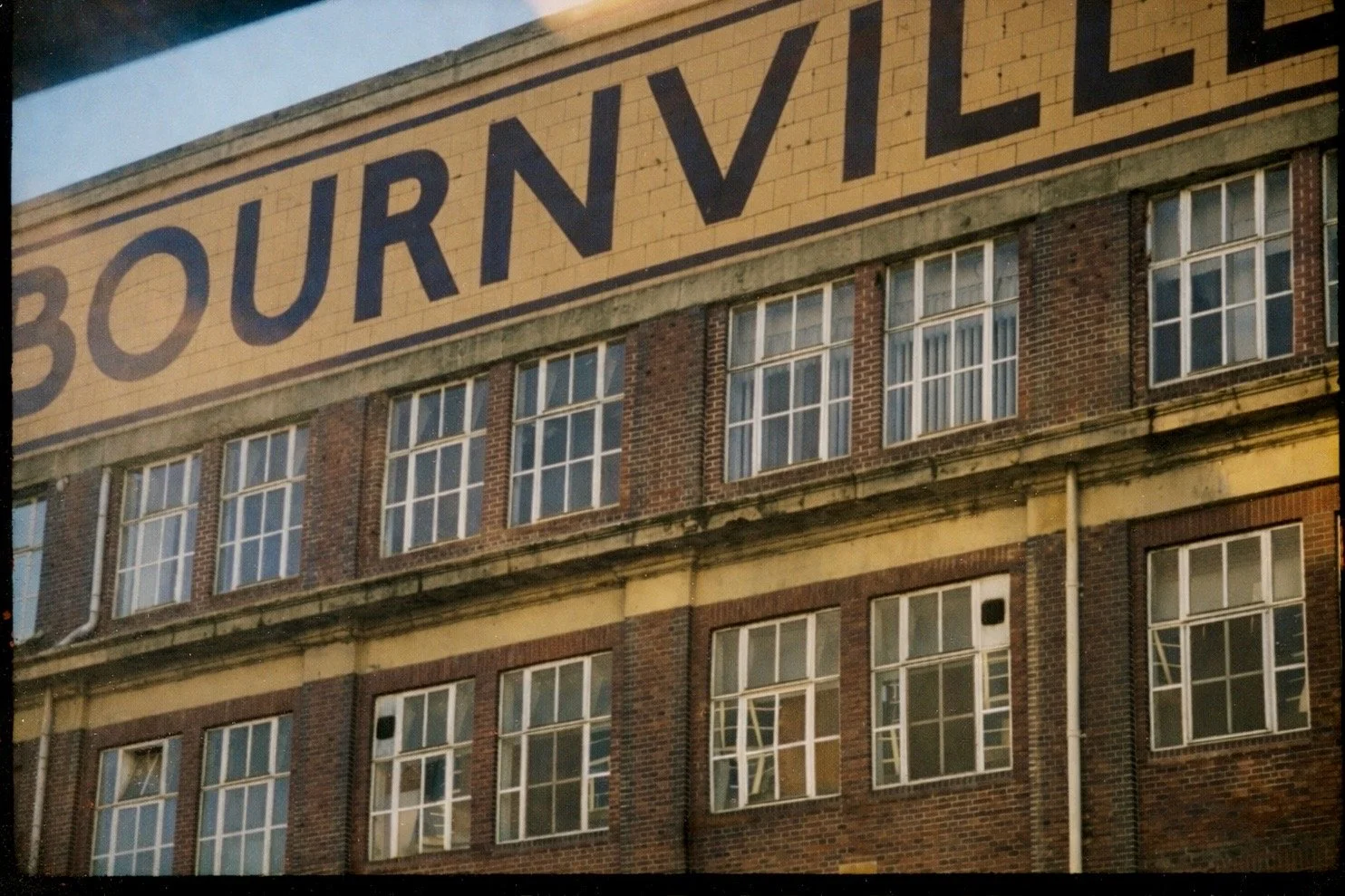
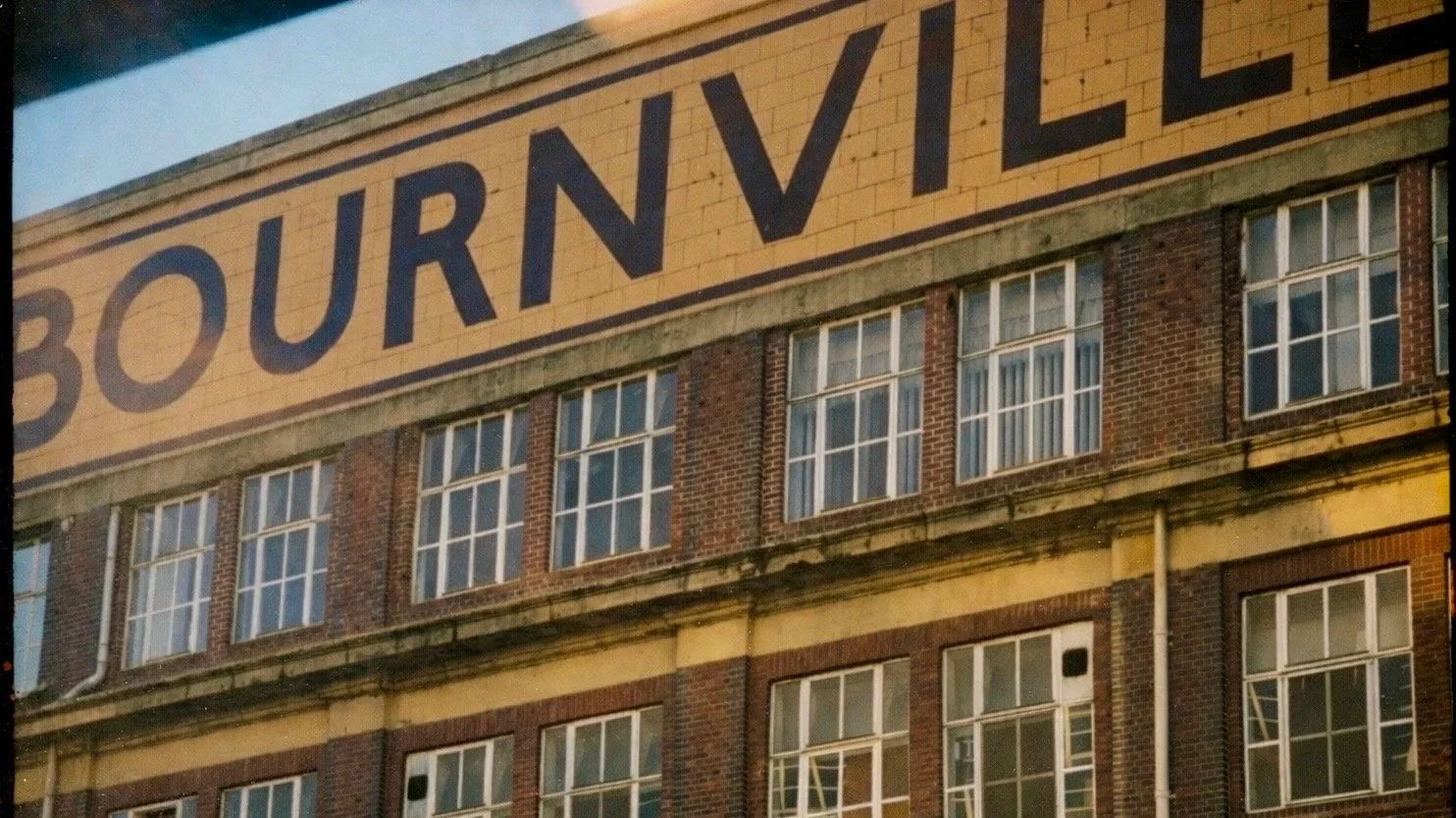
As the doors crash open and the sea of Oompa Loompas in front of me washes out into the factory experience beyond, I am hit by the rich smell of chocolate filling the air. I can’t believe it is a synthetic scent pumped out for atmosphere — no, this must be the pure essence of cocoa escaped from the monolithic operation next door. Catching a glimpse of the real factory through the windows, its name built into the building’s fabric in metre-high letters, the red-brick chimneys looming imperiously over the symbiotic surrounding village, I know that this smell is the real deal. Great columns of steam gush into the freezing air above the bustling factory; if only it were purple, I would truly believe this Goliath structure was Willy Wonka’s own.
The children rush to a marble-topped display table, where an older lady — wrapped in a white lab coat, topped with a chef’s skullcap and gloved to the elbow — welcomes her audience like a Butlin’s magician and begins her demonstration. Her words echo back to her from a sea of hungry mouths, the free bars of chocolate rising to their final Chomps. I stand well back, not wanting to seem too interested in her presentation, but her words grab me, and I note the titbits she throws out while scraping and tapping dripping chocolate into moulds, teaching her students the secrets of tempering. With a straightening of her back and the jutting out of her chin to look down on the males present, she takes obvious pride in telling her audience that “since the early days, tempering has always been done by the ladies and girls at Bournville.”
“Well, that’s interesting,” my internal monologue exclaims, ticking over in my head — or at least I hope it’s internal; I already look weird enough over here. ‘Cadbury Angels’ they were called until the 1960s, when gender segregation in the workforce came to an end and men were deemed worthy of chancing their arm at tempering the family’s ambrosial produce, though much of this side of production remains in female hands to this day, as I come to learn.
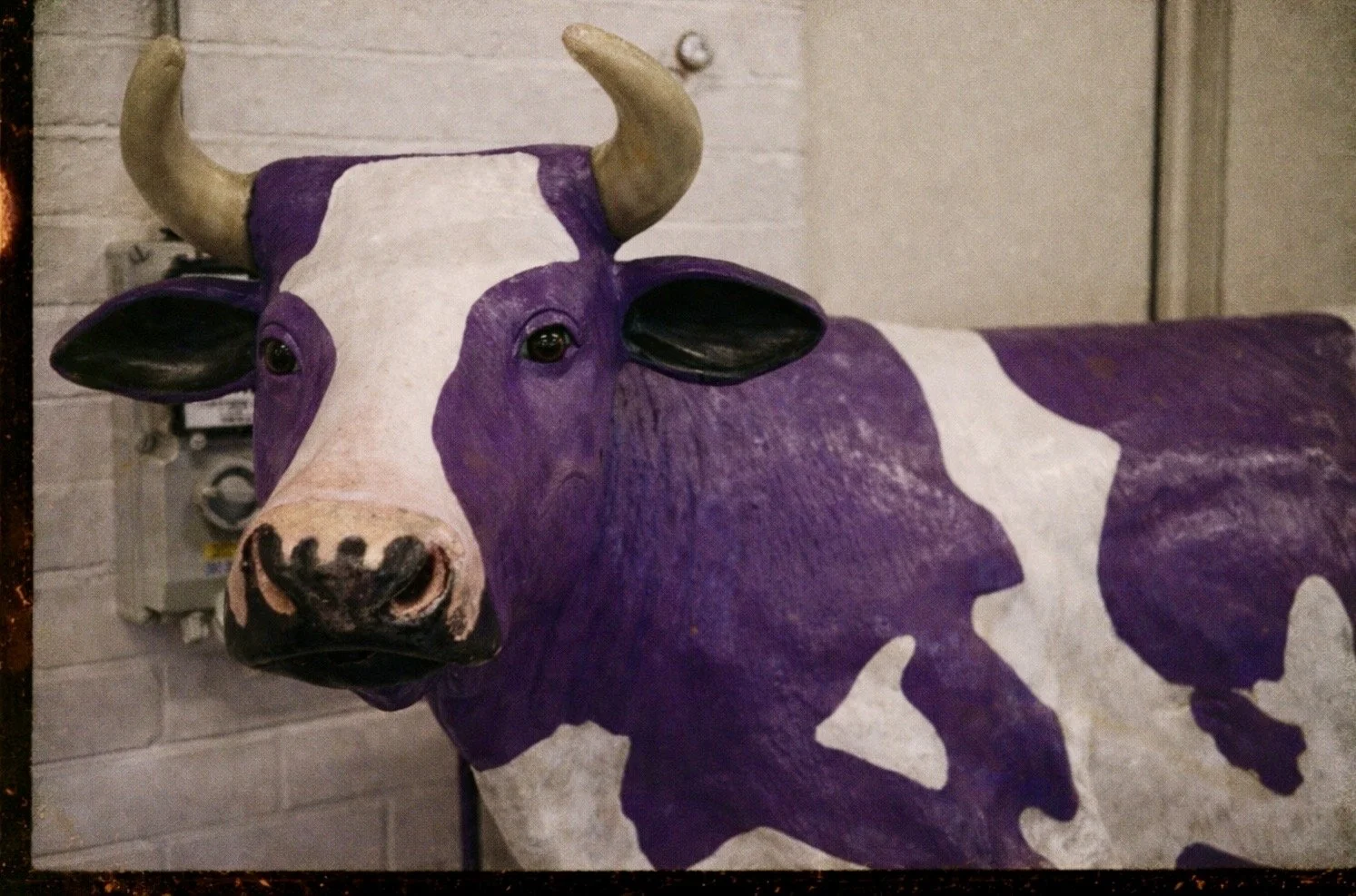
The tide turns away from the little old lady and her marble-topped counter, and I’m swept up in the rush of tiny feet as we’re ushered into the next section: a bright white laboratory with walls of rich Cadbury purple, windows positioned to left and right revealing a host of ‘Cadbury Angels’ hard at work. My attention is momentarily fixed on a little purple-patched cow with golden horns and a gentle, inquisitive face, tucked away in the corner on its own private patch of grass. I love it, and I’m not sure why.
However, my interest in the cow is solely my own, the rest drawn like bees to honey across the room to the only destination that seems to matter: the chocolate fountains. It’s time to hang back, take my time, take in the artwork on show — protected behind Perspex glass and safely out of the reach of little hands, hungry mouths, and shallow pockets. It’s not just the art; I find myself more interested in the artists, the choir of white-robed angels hard at work behind the glass, effortlessly producing the most precious pieces of chocolate this side of Geneva. Granted, some pieces are more fun than Renaissance. I see a triad of dripping moulds rotating and spinning around a silvered machine on the other side of the room, chocolate footballs soon ready for setting and embellishing. Chocolate steering wheels fit for a champion line a shelf in the workspace beyond the windows, and milk chocolate plaques lie stacked, ready for the messages they will carry with them to their final destinations; messages of congratulation, birthday wishes aplenty, messages of love, of proposal perhaps — apologies ready for the addition of a bouquet seem to be the order of the day, I note. I even spy a row of those most mythical chocolate teapots — there’s a joke in there somewhere, but I’m not the writer to find it; in fact, I’m about as useful… — all ready for the elegant piping of frills, flowers, and love hearts in shades of milk, white, and dark.
I’m standing rooted to the spot, transfixed and gawping like a goldfish from behind the aquarium walls, when I’m pulled from my stupor by an otherworldly character of Wonka-esque jubilation, pomp, and ceremony.
“All right, fella? You’re looking very dapper — what’s that then?”
All these words, rattled off quick-fire in a thick Brummy lilt, have the power to snap me back from my dreamlike, chocolate-fume-induced haze. Shaking my head to clear the fog, it takes me another second or two to really take in the man stood before me. Uniformed in that same rich Cadbury purple as all the other worker bees here at Bournville, and equipped with a smile the like of which you wouldn’t imagine could be real, I realise it’s not his appearance but his energy that has me rapt.
But I’ve still not answered his question, his fingers pointed down at my open notepad, the scrawling handwriting unintelligible to anyone but myself — if I’m lucky. I explain my quest: that I’m on a journey around the UK, exploring all the wonders at our doorstep — and mumble, as an afterthought, that I might possibly, maybe, be trying to write a little something about my findings. Nothing important, I add. But my very own Willy Wonka — Jay, he introduces himself as — will hear none of this downplaying. All he’s heard is that I’m writing a book - “A book?!” - about where he works.
All of a sudden, I have an arm wrapped companionably — but firmly — around my shoulders, and I’m escorted hither and thither, introduced to all the Bournville faces. Manoeuvred right up to the window, Jay knocks to get the attention of all the Angels working hard at their craft. Before I can even become aware of the notion, I feel like an intruder. I’m sure they tell you never to tap on the glass — Dudley Dursley learnt that lesson the hard way, and it’s one I’ve chosen not to forget — but he’s got their attention, taken it away from their art, and I’m introduced to a waving Ruby, who’s worked here at the Bournville factory all her life. Simply wonderful stuff, and he’s off again, sweeping through the room, clearing a path with the powerful energy radiating from within him.
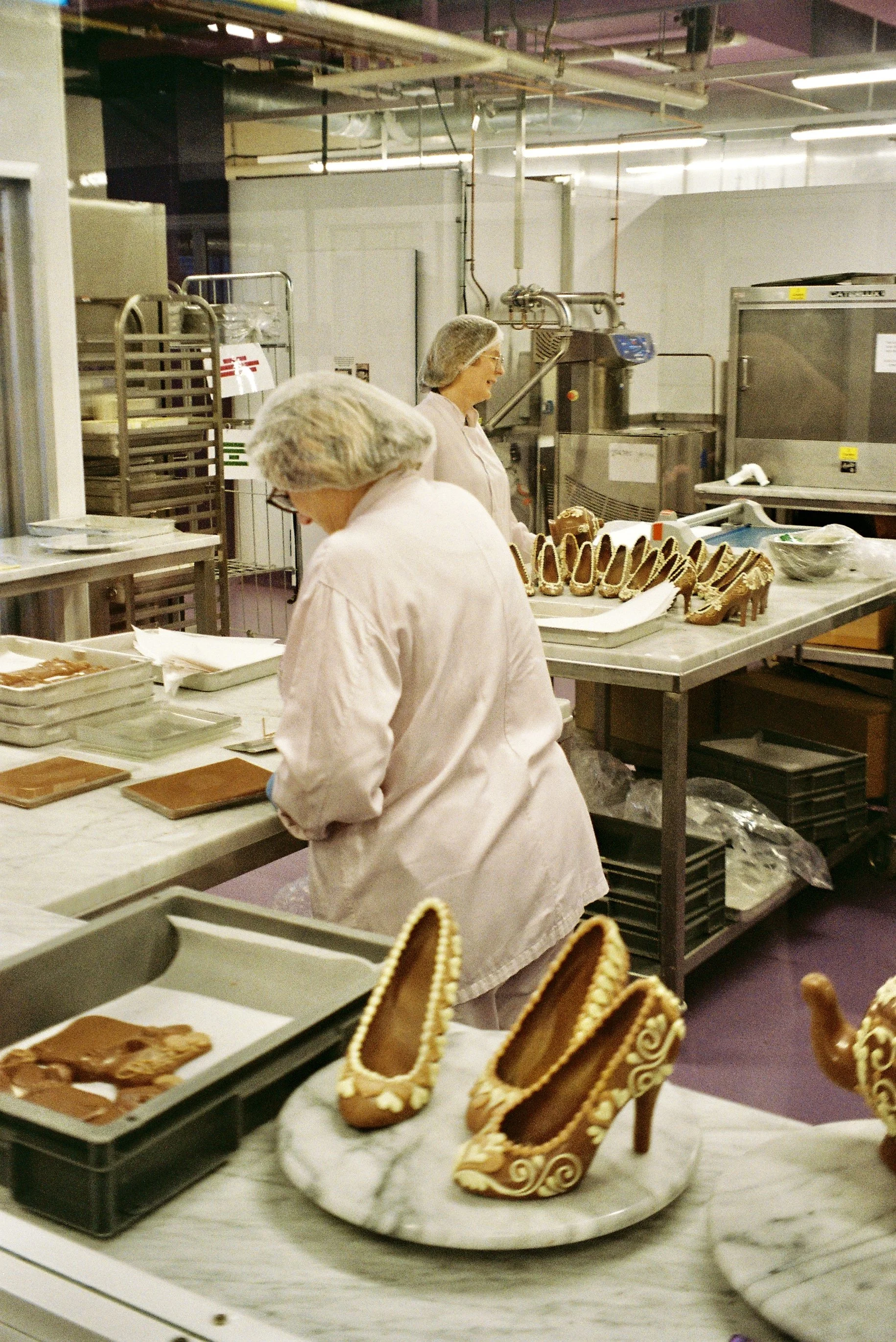
Left back where I started, watching Ruby pipe designs onto a chocolate slipper fit only for a Cadbury Cinderella to wear to the ball — my feet get too hot when I’m dancing, you see — I begin to sink back into a daze, lulled by the motion of the piping, one frill merging into the next.
A tap at my shoulder. Here we go again.
“You’ll wanna take this.” A pot filled to the brim with melted Dairy Milk Buttons is placed delicately into my hands — rich, velvety, and smooth, with a dazzling reflective sheen; a timeless classic, filled to the brim and pouring over with nostalgic excellence. I take the offered spoon and the seat that Jay leads me over to, told under no uncertain circumstances to plant my bum and enjoy the ride. Looking up to take in the polished pumps in front of me, I can’t help but relish the giddy pleasure of watching the melted chocolate pouring out of the taps — this constant flow of ecstasy, a never-ending stream of liquid goodness, caught in a cup and handed out to the hedge of outstretched hands waiting for their sample.
Lifting the spoon from its bath, I watch, entranced, as the strand of Dairy Milk rolls off the end, creating Twirling spirals in the well below. I can hardly hold my yearning any longer. I lift a spoonful to my mouth and am caught up in a wave of confectionery nostalgia — the taste so iconic, a taste that we all know so well; one that stays with you for life, through good times and bad, in times of celebration and heartbreak — a constant companion.
Jay is back again, his “Welcome, welcome” speech to the next group of chocoholics done and dusted. Whirling back into my life like a fizzing top, the man sweeps me up onto my feet to follow him this way and that once more, in a hail of introductions to the few remaining Cadbury Angels I have not yet interrupted. I meet this man and that lady, each one full of life and love for the work they do, but slightly confused by what it is I’m doing. I shrug. I’m not too sure either.
“Would you like me to grab the managing director of Cadbury World for your book?” What I would do with such an exalted figure, I’m not sure — but maybe it would come with some more of those free choccies. I politely decline the opportunity. I don’t want to be a burden, although I can’t help but feel like one. I certainly wasn’t expecting such a buzz, and having not spoken to anyone for anything more demanding than ordering my breakfast, I’ve seemingly forgotten how to use simple words or form meaningful questions for the people I’m meeting.
“You must meet our star, Nancy — she’s got a story for you. I’ll tell you, no doubt about it, it’s a story for you!” A path is cleared right through the eagerly waiting crowds to the front of the pumping station. Nancy looks from Jay to me and back again; I can see the questions written on her face, but there’s neither the need nor the time to ask them, as Jay is off like a sprinter at the starting pistol, souped-up on sugar and ready with the introductions.
“Nancy’s one of our Angels — she’s been here all her life, haven’t you, Nancy? But Nancy’s Lee, we just met Lee — they met here, didn’t you, Nancy? Met here at Bournville.”
I pray the man will take a breath as Nancy nods away, her story told for her. I feel it necessary to start again and have it reconfirmed by the wonderful woman herself: that she has been here at the factory all her professional life, just like Ruby. It’s the same for so many others who find a home at Bournville. Between her and her husband, they have over fifty years of Cadbury experience — an enviable chocolate education, though one I don’t think my teeth would survive.
It’s a real chocolate chronicle. Nancy and Lee met in the factory; two of their three children have followed in their footsteps into time at work in Bournville; and when the pair were married, the company officially recognised the union with a certificate of congratulations and — I’m told — a beautiful chocolate rose. To top the whole thing off, their wedding was celebrated in a congregation of purple shading.
Purple. Tying together this whole experience. Woven into the very fabric of the enterprise; the company, the bricks and mortar, and all those who work within them, plus the many millions who love their produce. Purple, purple, purple. When you see that shade — at least for me — Cadbury is all I think of: Cadbury and their Dairy Milk. What power that is.
Pantone 2685C — the technical, and rather uninspiring, name for the iconic shade of indigo — wraps the Cadbury brothers’ confectionery, coats the factory doors, and gowned the bridesmaids and suited the groomsmen on Nancy and Lee’s big day. It was first used to wrap Dairy Milk in 1915, as a tribute to the late Queen Victoria, a royal reference that stretches much further back than just their original regal follower, the “Grandmother of Europe.”
Purple has been a symbol not just of royalty, but of luxury and power, for well over 3,000 years — ever since the age of the Phoenicians, the ancient Greeks, and their Roman successors, when it was only possible to produce the imperial shade by harvesting the mucus of sea snails; a process which, I’m sure you’ll agree, sounds most undignified, sticky, expensive, and time-consuming — making the dye extracted as valuable as gold. Cadbury made this colour completely their own; the power of its recognition, and its relationship back to the Bournville chocolatiers, emblematic of their Herculean strength in advertising, with which we are all so well acquainted today.
Everyone knows the drumming gorilla and the funky-eyebrow kids. Ask your dad what a Flake means, and you might just see a little blush in his cheeks; likewise your mother’s when you bring up a Milk Tray. All these marketing marvels are thrown up at me for nostalgic pleasure in a trip down memory lane — Cadbury World’s Advertising Alley. New legislation passed by the UK government means we may be denied the amusement of great advertising campaigns run by Cadbury and their competitors, as it is now illegal to advertise so-called “junk food” before the watershed in a bid to reduce childhood obesity.
I’m almost certain there are better ways to achieve this undoubtedly noble endeavour — like funding local sports initiatives and youth clubs, for a start — but I’m no politician, thankfully for the British establishment. But let’s look on the bright side: maybe this will free up Cadbury to conjure a whole new take on the Flake ads of old. We can only live in hope.
“Can I get you anything, love?” I’m at the create-your-own chocolate station after all, and although I’m sure Nancy loves reminiscing over her wedding day, I’m equally sure she’d much rather get on with the job at hand and clear the backlog of customers impatiently tapping their feet behind me while I natter on.
“I’ll leave it up to you — you’re the expert here, and I trust you implicitly.” Famous last words in the presence of a wide pick-and-mix selection of ingredients.
I end up with a cup of, quite honestly, the strangest concoction I could’ve thought up: melted Dairy Milk, white chocolate buttons — I do not like white chocolate — marshmallows, and pieces of candied ginger. It’s only right to point out here that although Nancy was absolutely lovely and I had a great time chatting with her, not every confectionery creation is a celebration — they much prefer Heroes here anyway — and this one certainly landed in the let’s try again pile, right over there in the corner, behind the bins, which is where my cup ends up. Thinking of it, maybe she just wanted to get rid of me? In which case, fair enough. Well played, Nancy. Well played.
I quickly come to the realisation that everyone else in my party has moved on, and a fresh flood of childish glee is beginning to rise as the next batch of sugar-pumped, work-shy, overgrown toddlers come racing around the corner. I make a point of thanking Jay and promising to include him in my words — promise fulfilled — and race around the opposite corner, pushed on by a crescendo of high-pitched voices and laughter.
At the bottom, I’m faced with a decision: the 4D Freddo Experience one way, the Bournville Room the other. Turning right, I see my batch milling around in the cold outside a circus tent housing the former, a member of the Cadbury team handing out flimsy 3D glasses while they wait in the drizzling sleet for the fun to begin. An easy decision, then. I swing left and into the Bournville Room.
Quiet. Calm. Wood-panelled, with the air of a library in a stately home — books lining the walls and a model Garden Village depicting Bournville at its epicentre. I’m hooked, my pad out, ready to dive into the information boards being passed over by most of those I share the room with, the kids quickly realising there’s no free chocolate to be had in this particular exhibit. But this is what I’ve come for: the revolutionary ideas of Richard Cadbury and George Cadbury, men who valued their workforce like none of their rivals, who wanted for their people a better life than could ever be offered in the smog and grime of back-to-back industrial Birmingham.
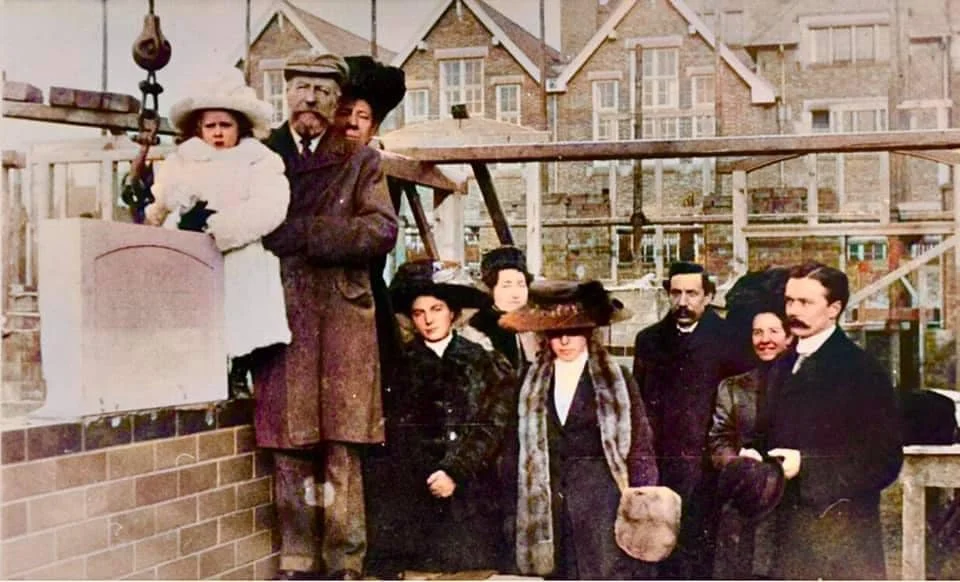
The Cadbury brothers moved their operation out of the inner city to the outskirts of Birmingham in 1879, to what were then green fields and unadulterated pastures, building their great new factory and taking their urban workforce with them. George, the younger of the siblings, was struck dumb by Brum’s residential conditions: “Surely everyone who passes through the backstreets of Birmingham must be touched by the thought that in so many districts the little children have no place in which to play, except the dirty and dangerous streets.” Openly criticising the practices of landlords, he and his brother decided to challenge the norm.
The Cadburys acted on their outrage when designing and building their new Garden Village, providing their workforce with all they believed was needed for the enrichment of life — and, by extension, the betterment of their company as a whole. What followed were spacious, clean homes; playing fields; free schools; public libraries; public baths; subsidised healthcare; and — to this day — no pubs. For, in George’s own words: “How can a man cultivate ideas when his home is a slum and his only recreation the public house?”
John Cadbury’s Quaker values had clearly passed down to his boys. They showed a love for their community almost unmatched at a time when human exploitation was commonplace. The brothers almost certainly drew inspiration from the 25 years of success achieved by wool magnate Sir Titus Salt and his model village, Saltaire, and made the easy decision to place philanthropy at the very heart of their business ethos.
The idea for Bournville was not, however, an overnight pipe dream lifted wholesale from Salt’s plans. John Cadbury had held a vision for a Model Parish Experiment as early as 1849 and even began selling special-edition cocoa, with proceeds going towards its planning and development. Though he never raised the funds to realise the dream himself, the endeavour almost certainly sowed the seed for his sons to nurture and bring to fruition thirty years later. Luckily for Cadbury Snr, he lived to see the embodiment of his vision bursting with life before his passing in 1889. I can’t imagine there was a prouder father at the opening of Bournville in September 1879, when those first workers stepped off the train from the Birmingham smog and into their new homes — into a new life.
Today, Cadbury’s Bournville produces around 360 tonnes of chocolate every single day — some 5.5 million blocks of Dairy Milk alone — a veritable fortune wrapped in purple. But to George, the monetary value of his family’s confectionery empire meant little. He famously argued: “If I had spent a fortune on pictures, I should not have had it to spend in the ways which seem to me more important. Why should I hang fortunes on my walls while there is so much misery in the world?”
Standing here, looking up at his portrait, I wonder whether this image was one of the few he allowed himself in life, or whether it was commissioned posthumously by the company. As I stare into his solemn face, I’m struck by the thought that we may live in an age of some of the worst rich men in a human history long dominated by rich men. If we must, let’s confine that judgement to modern history — antiquity was, after all, a far crueller place. The richest of the rich have always had a hand in funding war at scale: Marcus Licinius Crassus bankrolled Julius Caesar’s conquest of Gaul. Yet at the opposite extreme, Mansa Musa, the richest man in recorded history, destabilised the Egyptian economy by giving away so much gold to the poor of Cairo that it became almost worthless. Every era has its golden boys.
Regardless, the art of philanthropy — the duty of the rich to the masses — feels today to be on life support. The Cadburys built a community. Andrew Carnegie built libraries and championed education. Even the House of Medici — ruthless and scheming though they often were — bankrolled the Renaissance and supported artists who created works of unquestionable beauty. What, I wonder, do the rich today give back to the people who fund their wealth?
“You’ll learn a lot in this room, I’ll tell ya that.” Jay is back at my shoulder, pulling me from the edge of that dark, dark pit of questions. Just like Wonka himself, he understands the character — the benefits and the dangers — of each room we pass through.
But I’m done here, my admiration for the Cadbury family at an all-time high, as I’m sure it’s intended to be after that carefully curated selection of facts, quotes, and testimonials. I choose not to indulge the opposition squeaking at the back of my mind — though I know those questions are valid — and instead stick with the positives.
Alright, then. I’ll question it for you.
The brothers were undoubtedly good men with well-calibrated moral compasses, but their enterprise was still capitalism — albeit softened with socialist bearings. I’m sure the farmers in far-off lands growing cocoa for third-party suppliers did not enjoy lives quite as comfortable as the workforce at Bournville. But perhaps you must dance at home before you dance abroad. In later years, Cadbury became a major contributor to the Fairtrade movement before establishing its own sustainability programme, Cocoa Life — meaningful strides toward redressing imbalance.
They were also men of their time, choosing not to employ married women among the ranks of the Cadbury Angels, believing a woman’s place was in the home. Times have changed. Again, I choose to focus on the good when shaping my judgement. Hollie says I live life through rose-tinted spectacles. And a nice life it is too.
I exit through the gift shop, for it is the way of such things. However, for once I’m actually on the lookout for a purchase — something I remember from a visit here in my childhood, all those many years ago when I ran from room to room in unabashed glee, in a manic search for more chocolate, more chocolate, more! I remember the pure astonishment when I left here last time with a bar of Dairy Milk the size of a small child and weighing just as much. I was convinced this gargantuan confectionery monstrosity must be mine once more, despite the buckets of Heroes and Roses I had already consumed over the December festivities.
But alas, the bar I find is nowhere near as massive. Yes, it’s big — bigger than standard, of course — but not gargantuan, not mammoth in portion size. I stop a passing member of staff in her tracks to query my findings.
“Excuse me, where’s the big chocolate?”
The look I receive can only be described as one of pure resentment — that same face you try to hide from the idiot at work when they ask the most obvious and inane question imaginable.
“It’s right there. You’re looking at it. I just saw you pick it up?”
Returning her gaze with blossoming awkwardness, I ask the fated follow-up.
“No — not this one. The really big one?”
She quite clearly now thinks I’m possessed of immeasurable gluttony, worthy of my place in the third circle of hell, forever tormented by Cerberus, the three-headed guard dog of the underworld.
“There is no bigger one.”
And she’s off, with a shake of the head and a visible curling of her lip. Shrinkflation must be at play here, I’m sure of it — or perhaps it’s just the overactive nostalgia of childhood memories taking control. I leave the gift shop empty-handed but stuffed to bursting with all the free chocolate my pockets can hold. That’ll show ’em.
Off and on, back to my little three-door, hidden away amongst a field of family wagons. I start the engine and pull out of my space, squealing across ice and snow — not quite the dramatic exit of little Charlie blasting from the roof of his chocolate factory in a glass elevator. Down the drive and past the chimneys, out again by the church and playing fields, all built by the Cadburys.
As I sit at the junction at the top of the drive, waiting my turn to sweep into the school-run traffic and on to my next destination, a structure glimpsed from the corner of my eye ignites my interest. I hadn’t noticed it on the way in, but now I see it clear as day in the low winter sun: a red-brick building, grand and authoritative in its stance, a clock tower crowning its frontage.
My turn comes. The car to my left flashes impatiently, but I later learn that this building — more specifically its clock tower — is a carillon, a striking copper-green bell tower inspired by one of George Cadbury’s visits to Bruges. Its inner metal workings — gears and pulleys — are exposed to the elements, exposed to public judgement, much like the inner workings of the factory now receding behind me, glimpsed one final time in my rear-view mirror as I crest the hill out of Bournville and into another satellite town, its name unimportant.
It’s funny: I’ve spent this whole experience comparing the factory and its characters to the secretive world of Willy Wonka, shut away behind iron gates with a golden ticket the price of entry, when my day could not have been further from the fiction. My ticket was purple, of course — not golden — and reasonably priced, especially when you consider all the free chocolate I’ve emerged with. No need to be Veruca Salt. Just Elliot.
It’s only later, in research, that I learn Roald Dahl was once a chocolate tester here during his school days. Maybe he too glimpsed those inner workings. Maybe they set the gears turning, whispering what a story this could be — and what a story it is, was, and always will be.
