Chapter One. (Part One.)
Part One.
West Midlands.
Birth & Rebirth.
My eyes snap wide open, instantly all too aware of the room around me: the sounds of my partner asleep beside me, the cars and motorbikes racing along the overpass above us. I reach out and grab my phone, that portal to the world outside which has the unparalleled power to keep us all in. I tap my deep black mirror, not wanting to catch the look in the eyes which stare back. 7:05am. Damn, it’s time. The time has come — no time like the present.
That feeling in my stomach; that ache, those knots, the flutter of Lepidoptera—the order of winged insects including butterflies and moths, if you were wondering. Bet you didn’t know that word when you woke up today? Don’t worry, neither did I until five minutes ago—all of it churning in the pit of my gut. I now know the amygdala—a small, almond-shaped cerebral structure housed deep in the cranium—is kicking the living daylights out of its neighbour, the hypothalamus, to get its act together and send those chemicals rushing through my nervous system. Adrenaline, norepinephrine, cortisol—and maybe, if I’m lucky, a little spoonful of dopamine to sweeten the lot—charge through my veins, pumping to my extremities and taking full control.
Fight or flight my arse—more like play dead and hope for the best.
Like Bruce Banner, I feel my soul is filled up with someone else: not the big green monster-hero of the Marvel universe but a little blue goblin instead, trying to convince me of all those dark thoughts. “It’s not right for you”, “who do you even think you are, trying something new?”, “completely out of character”, “everyone will think worse of you”. Imposter syndrome is the force rushing through my veins and taking over my insides, burning the positives away.
My mind’s telling me no, but my body—my gut, my second brain—is also telling me absolutely not. I know all these specifics regarding the sensation attractively coined “butterflies” because, instead of getting up and getting to it, I spend twenty minutes in bed, cowering in the dark, seeking out this particular scientific enlightenment.
To tell the truth, I really do feel rotten, in the final throes of that winter bug which grips the UK every Christmas as we all mix and share festive embraces. But I’d set this first Monday of the year aside to venture out in exploration of that mystic land beyond the fogs. The West Midlands is calling.
I shake the malaise from my body as I swing my legs out of the warm cocoon Hollie and I have created for ourselves. The air is fresh, to say the least, even in the safety of my own home. A coffee and a shower to warm my soul and I’m off, the curtain pushed aside and out the door.
Thank goodness the sun shines bright from clear skies, blue draping the heavens from horizon to horizon—not that I can see further than the roofs curtailing the landscape around me. The angular tiled ridges break up any natural panorama like the peaks of an ECG reading, mirroring the rushing of my own heartbeat.
The world around me shimmers and shines back from every surface. The ground sparkles; the wooden garden table has a reflective layer that its natural characteristics should not allow for; and now I know the car will be encased—petrified in its own right—within a cocoon of ice. Not perhaps the start I was after, but alas the start I have got. Time to harness some of that superhuman strength the amygdala has imbued my body with and get to work scratching and scraping the shell from my steed, to be born anew into this day of adventures we have in store.
The first adventure of many. I pray my little Mini is up to the task. I pray I have the strength of will to follow suit.
--------------------------------------
Stratford-upon-Avon.
The car slowly warms as I begin my journey out of London, out past Heathrow Airport, where all those souls take off, hurtling into blue skies in search of new experiences in lands over the horizon. My own journey keeps me firmly anchored to terra firma, hurtling not through the heavens but through the silver-frosted fields of middle England, cutting a path through the undulating landscape of the Chilterns on my way west. The frigid winter sun at my back slowly rises to cast what warmth it can over these frozen pastures.
My heart is still full of that same trepidation from my waking moments, made all the worse by the fact that I can hardly see the road ahead—both literally and metaphorically—the grit sprayed up onto my windscreen blinding me to the world around and the trajectories of my fellow travellers. I pull over and do my best to clear the muck my wipers are making such little headway upon.
Shall I call it a day? Shall I turn back? Falling at the first hurdle doesn’t sound quite right to me—failure, or more rightly, surrender.
A change of tack is in order, and my journey continues to the rapturous vocals of Olivia Dean, a personal concert happening within the confines of my Mini Cooper. I sing out with all my soul to the world around me, allowing the words to fill my heart with the warmth I crave.
“Welcome to Warwickshire, Shakespeare’s County”
The first sign—literally—that my destination is within reach. The world around me shifts into a new gear: the Home Counties, blanketed by frozen dew, replaced by an Arctic panorama of bright white snow carpeting the fields to left and right, the drifts pressed up onto the verges of the motorway. My exit calls. I merge gingerly to the left—over one lane, over two—following the brown signs for The Birthplace of Shakespeare, Stratford-upon-Avon. The signs lead me on into the countryside, the wide arteries which string this nation together replaced by veins, and again by capillaries—country roads—which scare me, a city boy, even on a summer’s day.
But I’ve made it.
I pull into the car park in Stratford town centre, all the cars around me still piled high with the product of last night’s wintry deposit, my own a muddy brown in stark comparison, sprayed with the detritus of my journey. I step on, skidding and sliding, trying to keep my feet as the worn-out soles of my trainers scream out, “I am not prepared for this—and neither are you!” I round the corner and am faced with the bronze personification of my own internal conflict, that voice in my head, here in front of me, so very real.
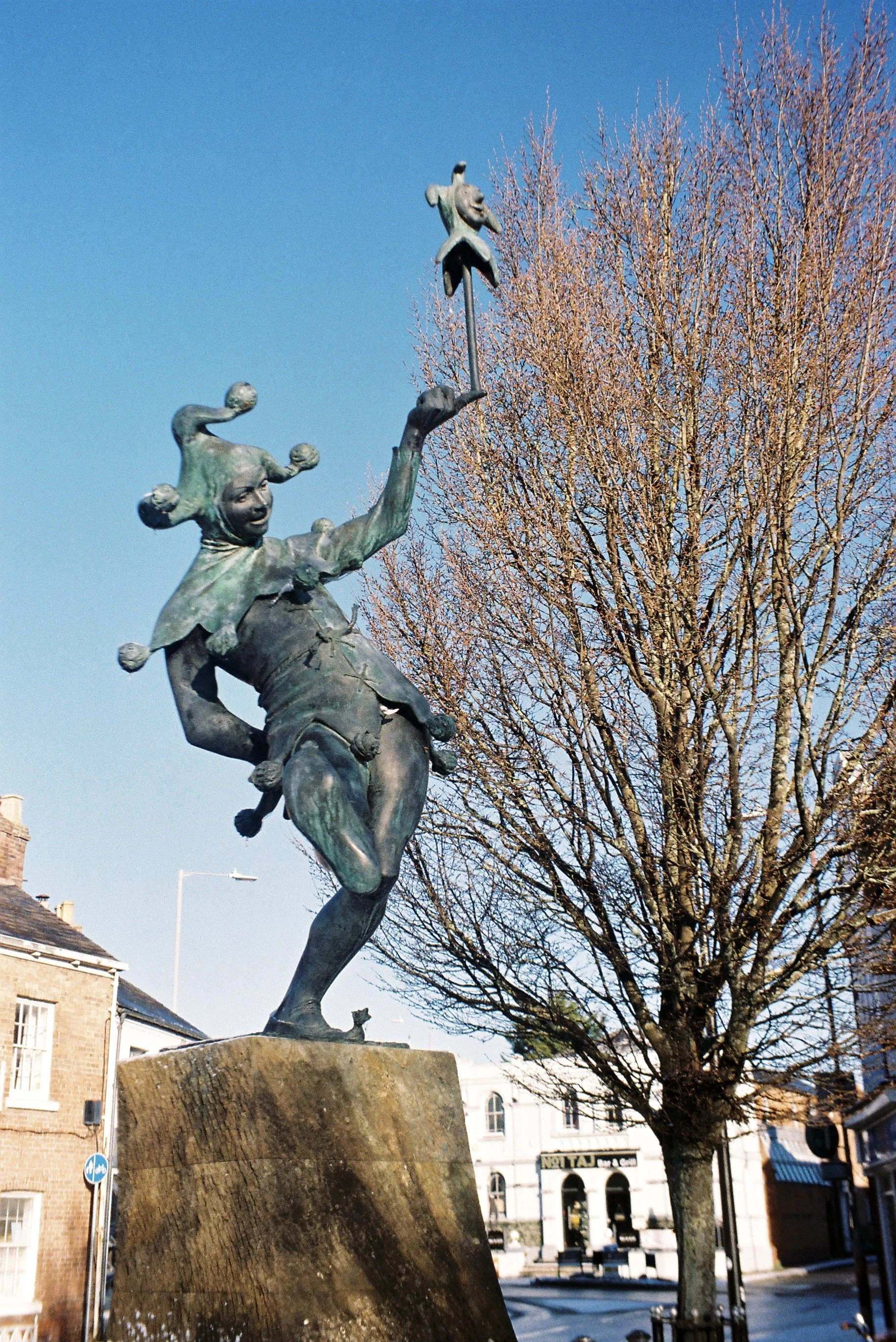
“When I was at home, I was in a better place…”
Touchstone the Fool in As You Like It puts words to my struggle. Stamping my feet and clapping my hands to generate some warmth, I’m struck dumb by the contented image of a warm bed so very far away, over many hills back along the rising path of the winter sun which sits idle in the skies above, shirking its primary occupation in my opinion —
“… but travellers must be content”.
“Too right!” I say to myself out loud, to the bemusement of a pair of passing tradesmen.
It’s a beautiful day. The snow dusting the cobbled market street gives this setting a luminance I’m sure could not be replicated under any other conditions. Maybe I am the Fool—but they always have the most fun—so it’s time to embrace the journey and be born anew, out of trepidation and into adventure. I give the jester’s pointed shoe an affectionate rub, thanking him for his words of wisdom just as his master, Duke Frederick, and the audience have so many opportunities to do in his play, set in the magical Forest of Arden inspired by the very landscape I have just arrived through.
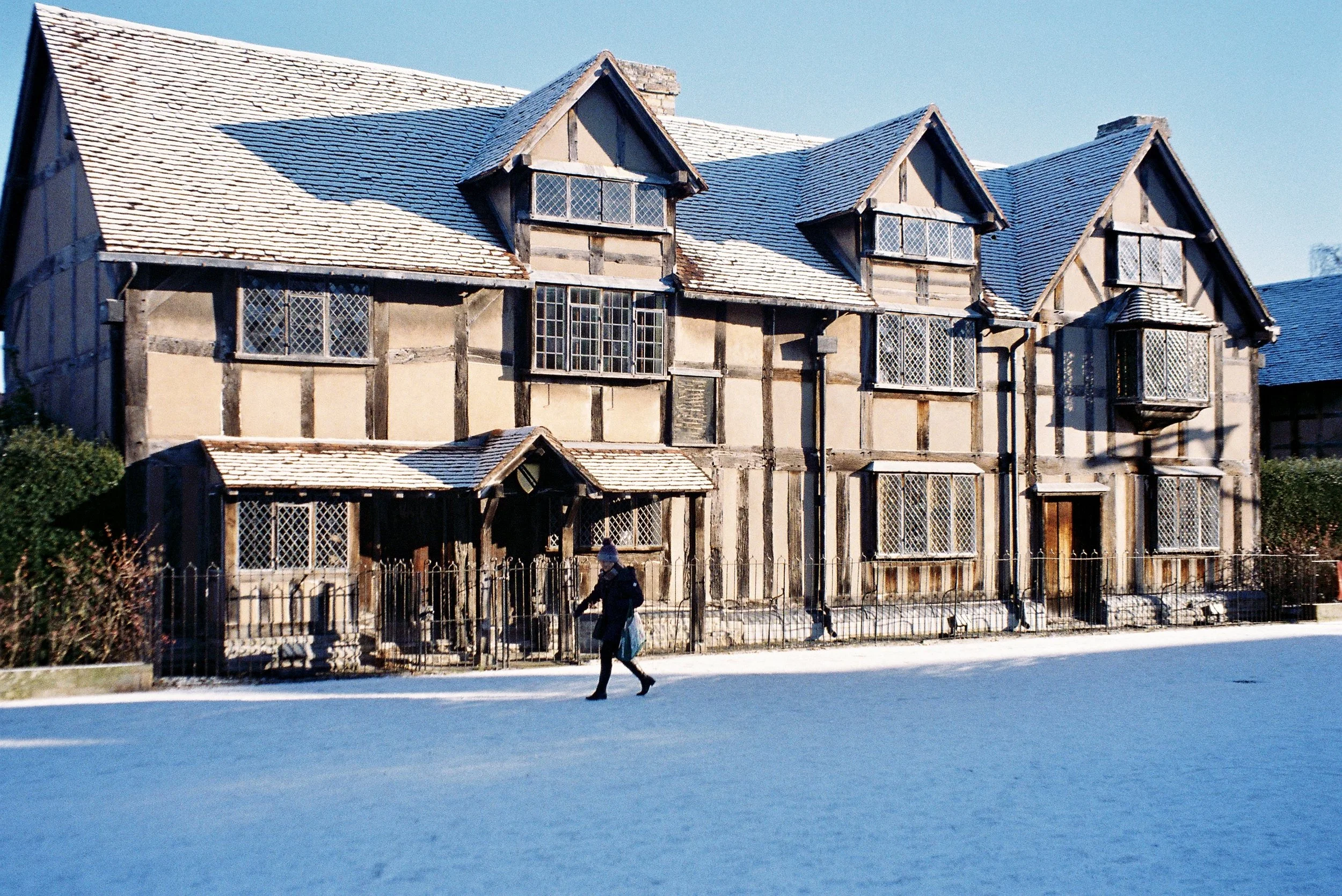
To my right stands the Shakespeare Centre, a modern building built in the 1960s to inform and educate the hordes of summer tourists, closed today in the face of its winter visitors. Next to this glass-shuttered edifice, standing solitary despite its neighbours, the building simply called Shakespeare’s Birthplace sits silently, all its windows dark. Its doors are likewise closed to the outside world, but in a way that only feels right, protecting the magic held within.
The simplistic name of this historic building strikes me as underwhelming: Shakespeare’s Birthplace. I expected something more flowery, more poetic, to signify its importance to the cultural fabric of the world at large and its role in British literary history. But perhaps truly, “striving to better, oft we mar what’s well.”
I take a seat opposite, brushing a patch of bench clear of snow, and take stock of the scene before me. The period structure radiates a low hum of energy, only faintly perceptible to my mind, the wooden beams tying wattle and daub together like a skeletal network, giving it that distinctly Tudor character I feel so nostalgic for. Snow covers the roof slates, giving the building an almost cartoon outline as the black edges prick out against the white.
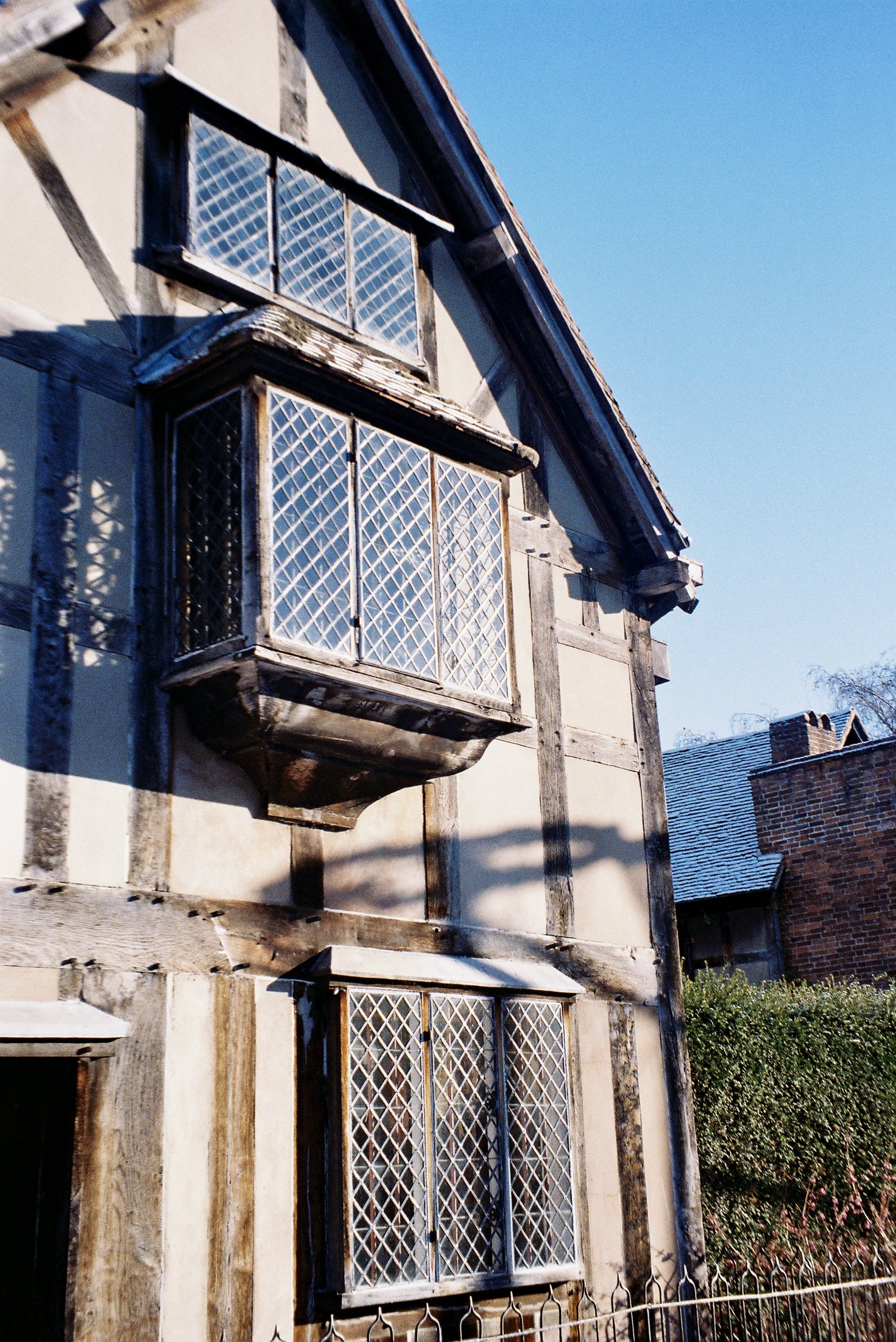
One feature grabs my attention above all else: an oriel bay window thrusts out over the street below, and I can’t help but imagine a young William Shakespeare sat there, peering through its diamond lattice, taking stock from his commanding position and conjuring stories born from the bustle of everyday life on the ancient market street below.
Those stories, I’m certain, would go on to change the world. There’s no denying it, no arguing it, no quantifying it. It’s a fact — and I’ll hear no other point of view, alright?
William Shakespeare —The Bard of Avon — author, poet and playwright, is credited with writing around 36 plays — 37 or 38 depending on who you ask — and 154 sonnets. Many are so deeply ingrained in our cultural makeup that they spring forward unbidden to the forefront of your mind even now.
These plays span — and in many cases redefine — their genres: tragedy (Othello, Hamlet, Macbeth); comedy (A Midsummer Night’s Dream, Twelfth Night, As You Like It); and history (Julius Caesar, Henry V, Richard III). His plays are performed more than any other and have inspired over 2,000 film and television adaptations, practically every ‘star crossed lovers’ story is an inspired retelling of his own Romeo and Juliet: James Cameron’s Titanic and Avatar both telling the same tale just worlds apart. So powerful is the legacy of his work that many of history’s most famous quotations are remembered not from the figures themselves, but from Shakespeare’s characterisation of them.
“Friends, Romans, countrymen, lend me your ears…” Mark Antony’s opening line in Julius Caesar rivals even Caesar’s own “Veni, vidi, vici.”
“Once more unto the breach, dear friends, once more!” Henry V’s rallying cry at Agincourt has become the blueprint for countless speeches in times of national peril. Winston Churchill’s wartime rhetoric echoes its cadence unmistakably.
Shakespeare is revered not just here on his native isles but globally: his works translated into over 80 languages, his plays performed on every inhabited continent. In 2014, the Globe Theatre Company performed Hamlet in 205 countries to mark the 450th anniversary of his birth. Over four billion copies of his work have been sold worldwide, making him arguably the best-selling author in history — sorry, Jesus.
Yet for me, his greatest impact lies in the language we use every day. Over 1,700 words and phrases still in common use are attributed to The Bard. So next time you gossip about your addiction to the swagger of a certain someone, don’t leave yourself in a pickle and instead wear your heart on your sleeve, go over there and break the ice because love is blind, face that green eyed monster because nothing is a foregone conclusion, stand not with bated breath, biting your thumb for until the game is up, the world is your oyster because you have a heart of gold! - Apologies. That was the best I could do. I’m no Shakespeare.
The birth of a culture. The birth of a tradition. A language, a style, a feeling. For all of this, we can thank Shakespeare.
I break free from this reverie, snapped back to earth and my surroundings by the sight of a father and son playing in the snow, throwing snowballs back and forth, giggling as they slide past the wooden door to this humble building — an iconic birthplace. A brass coat of arms hangs from the gable supporting the entranceway, striking in its simplicity, the honour of its family name evident at a glance from its heraldry. Gold lays the foundation, a black sash slashing obliquely across its centre, with a golden quill standing proud against that band of midnight. A perfect insignia.
Henley Street stretches out left and right of my icy perch, the Tudor shopfront façades mirroring the building which has commanded my attention so effectively until this point. I allow myself a moment to take in the full scope of the street’s beauty for the first time, my focus having been pulled tight by the magnificence and meaning of the home in front of me — if not its structural excellence — for such a long time. All of a sudden, I can see clearly the scene which must have gripped a young William Shakespeare, sat up there on his perch in the window above where I sit now: the market and the characters weaving in and out of the stalls set up along the snow-covered cobbles at my feet, the buildings around twinkling with the warmth of candles and hearth fires within.
Finally, I’m aware of the street around me, the buildings which make up the full picture—but it’s no longer the structures which have my attention; it’s the names. How did I not see it before, when now it’s all I can see? His name reflects back at me, bouncing kaleidoscopically off every surface and sticking here and there on the shopfronts flanking the road before me, swinging around his snow-dusted statue like a slingshot, sending his influence out into the town beyond. The Shakespeare Shop, The Shakespeare Repair Shop, the William Shakespeare Bookshop, and even the Shakespeare Distillery. I can’t for the life of me remember him as a man of such wide-ranging talents — his bust in the distillery window spray-painted with bright neon polka dots, the top of his head dusted and dripping with silver glitter — but I could be wrong.
I must look the Fool, my mouth agape, my head swivelling on its axis in unbound wonder, for an older gentleman, robed in a long puffer jacket down to his ankles à la Wenger, spectacles balanced precariously at the end of a blotchy red, dripping nose, has taken a special interest in my being in his town, on his street. He tuts in my direction and mutters to himself as he passes my station, quite deliberately loud enough for me to hear: “I can’t believe it, there are still tourists even now.”
Yes sir, there are — and I personally take umbrage at these words, whether they are meant for me or not, for it seems from the street around me that it’s these tourists who sustain the businesses which line this ancient market street. Anyway, I’m not a tourist, am I?
The old man has snapped the spell which had been cast around me, keeping the cold from my bones, and now, as “the icicles hang by the wall…”, it is truly cold. Now it is time to get in, out of this suddenly chilly atmosphere. I rise from my perch and step out, blown down the street by a gust of Arctic pressure, past the Shakespearean shopfronts and towards the town centre.
The quiet character of a little flagstoned alley grabs my attention and steers me away from the mainstream of life bubbling along through the centre of Stratford upon the River Avon. Tight and overhanging, hodgepodge and higgledy-piggledy in a way that only a bygone age free of planning restrictions can conjure up, this time-worn thoroughfare is a complete juxtaposition to the fashions of modern architecture, all straight lines and sterile symmetry. Down the alley the shops are an eclectic mix of the same ilk: a tobacconist, a sushi restaurant, and a travel agent, all peddling exotic luxury to the locals of Shakespeare’s County—but it is tourists from far and wide who brave the cold to be nearer one of history’s greatest men, a true national hero of my doorstep kingdom.
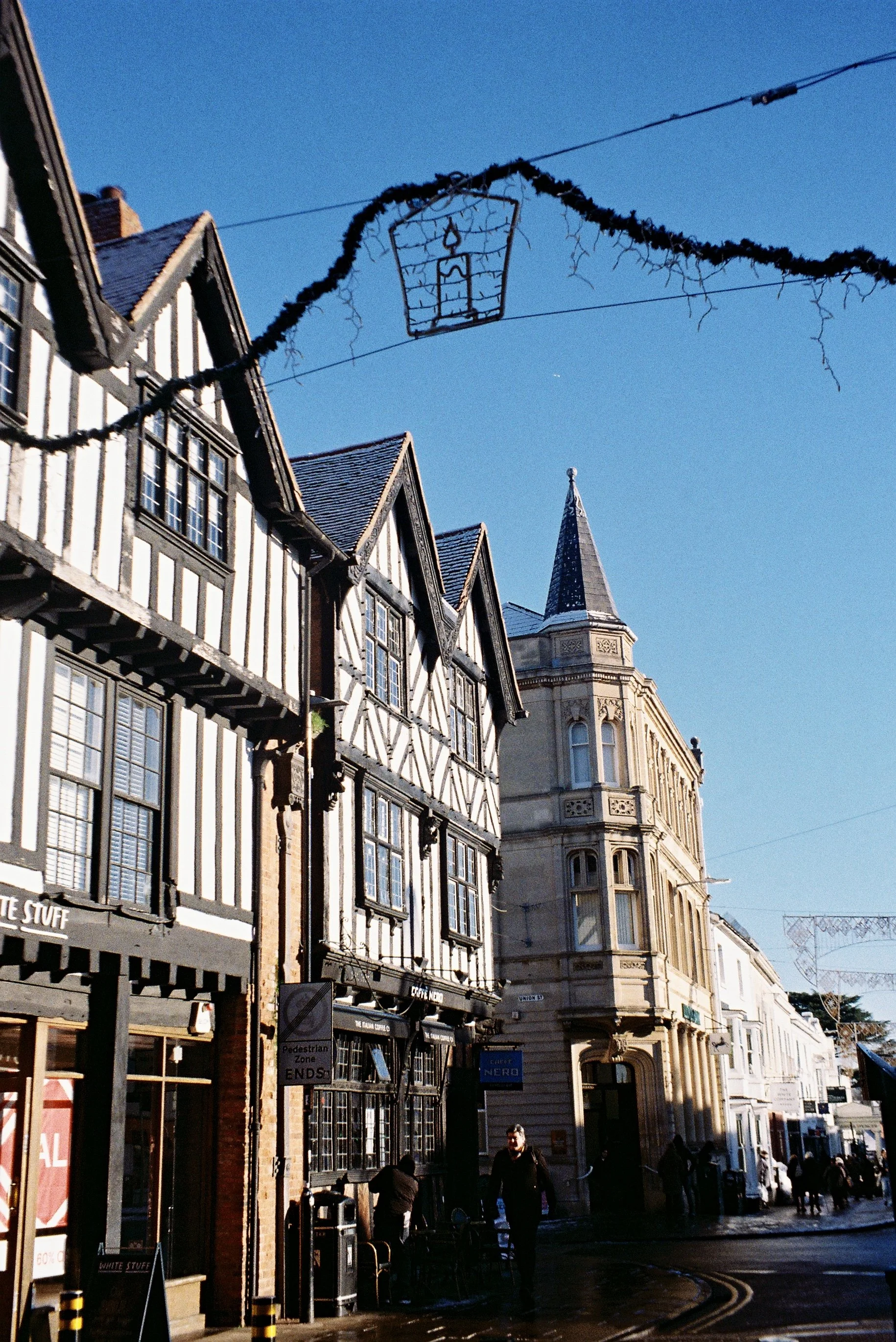
I burst out of the overhanging shadows of the alley, spewed from a pedestrian world into the mobile streets ahead, flowing with four-by-fours—the intermarriage of classic architecture and rumbling modern transportation suddenly offensive to any prevailing internal reverie. I try to look past the modern and see the town as it would have been in the 1500s, the hooves and iron wheels of horse and cart rumbling in place of the latest V8s, past the market house topped with a steepled clock tower on the corner of Wood and Henley Streets, overlooking Bridge Street which tumbles down to the gently flowing river beyond.
Today, that market house which housed young William’s father’s fine leather-working shop is a Barclays Bank, white and baby blue to match the brand’s colour scheme, the roadworks outside throwing off any sense of nostalgia with health-and-safety orange and the clatter of a jackhammer at ferocious work. Too bad—I was really getting into the swing of things, letting my imagination do the walking.
I’ve been recommended York's Café for a restorative breakfast by an expatriated local friend, off on their own adventure seeking life’s fulfilment in London, just as their ancestral neighbour, the Bard himself, so famously enjoyed on the South Bank of the Thames and at the court of Elizabeth I. I spy my haven from down the road and, as I grow closer, I can feel the anticipation building—not for anything extravagant, just for comfort from the winter world around me.
Inside it is wonderfully warm and snug, the orange glow of soft lighting and wood panelling cutting through any internal tension like a warm knife through soft butter, melting away apprehension. The metaphor sounds all too appealing. I sit quietly and whip out my pad to note down points of interest, thoughts and feelings which I hope not to forget — so often in one ear and out the other — the world around always offering more flashes of wonder to steal my attention.
I can’t help but overhear the order of the table opposite me as I have my head down, nose stuck in my notes. “Three iced white chocolate matchas.” My head jerks up suddenly — perhaps too suddenly to be subtle. Iced? Did I hear that right, on a day like today? They’re all younger than I am — I’m not old, not yet, am I? — their own heads buried in their phones, so they haven’t noticed my interest in their order, or the look of pure bafflement I’m sure I’ve failed to keep off my face.
My order is not so exotic: a black coffee and a bacon roll should do the trick. But I’ve missed the breakfast cut-off. I think the waitress can see the pure panic on my face, for I had all my hopes for the rest of the day riding on the restorative powers of a proper sarnie, so she promises she’ll see what she can do. My hopes raised sufficiently, I settle in and allow the snug atmosphere to wash over me, my mind rolling over everything I’ve taken in this morning—all the experiences, all the thoughts.
“The Fool doth think he is wise, but the wise man knows himself to be a fool.” Touchstone, the court jester, coming through with the pearls of wisdom once again.
I know I am truly the Fool, my fate in this role readily accepted. I now know I am painfully ill-prepared for this venture; for starters, I really need to invest in some thicker socks, as I still can’t feel my toes and I’ve only been outside for forty-five minutes—not a good start. I whip my notepad back out, not this time to ruminate on sights and sensations but to write a list of essential equipment for the rest of the day’s adventures: a phone charger and mount for the car, as I haven’t a clue where I’m going; those socks I mentioned; and windscreen washer fluid — essential, really, for seeing the road ahead.
I shake my head and mutter to myself, as only a desperate man can, about how “I only went out yesterday for essential expedition supplies — what the hell did I even buy?” It turns out the real master is experience, something I will have to learn, and learn again, over the coming months.
I am brought back from the internal inquisition occurring in the courtroom of my head as my sarnie arrives at the table, accompanied by a strong black coffee, piping steam rising from both. All is right in the world again. I’ll deal with those problems later—for now, it’s time to tuck in. The top of the roll housing the bacon I so require is slightly charred, black against the bright white enamel of the plate, reminding me of the slate roof tiles on Shakespeare’s home. Maybe it’s deliberate, like those burnt breakfast rolls I love so dearly in Scotland, or maybe it’s not. Either way, I couldn’t care less, and on a Baltic day like today I have no complaints. To me, it’s just extra warm.
My attention flits to the gaps in the fog bordering the windows. Another fool is dancing through the snow on the street outside, performing for a couple in a car sat idly on the road opposite the café. Does he know them? Are they good friends, or kindly strangers entertaining his revelry? I’ll never know—but he looks happy, and so do they, his rosy cheeks flushed and shining in the cool blues of the air around him. “Better a witty fool than a foolish wit.”
My sarnie is done, my coffee cup empty. I thank the waitress most heartily, for she has done me a great service, and I feel almost new again, ready to tackle the rest of the day’s exploration. I step out into the street anew. I look left, enticed by the continued stretch of Tudor façades, Hathaway’s Tea Rooms singing out their siren song—but I am already behind schedule.
“Right, Elliot, come on.”
Absolutely bewildered, I look down as a little old lady wrapped in a bright pink raincoat and crowned in a cream, bobble-topped beanie wanders past me, her hand held tightly around her grandson’s. He must be Elliot — and she must be right. I take her advice and spin on my heel, back up Henley Street to my noble steed.
Like a moth trying to resist the seductive power of naked flame, I try to walk on past the Stratford Sweet Shoppe, its bowed windows so inviting, the interior unchanged in generations. Jars of multicoloured goodies line the walls, and copper weighing scales sit eagerly awaiting their next payload. I am drawn in against my will by the timeless nostalgia — but I have no time. I stop myself at the door, pulling back from the threshold and that little bell I know will give its tell-tale ring to welcome my arrival, summoning forth a more-than-helpful shoppe-keeper ready to delight me and send me on my merry way, weighed down by armfuls of gumdrops, peppermints, and gobstoppers.
But no. I have another destination in mind. Another sanctuary of sugar-filled delight.
On to the Chocolate Factory.
On to Bournville.
