Chapter Two. (Part Three.)
Yorkshire.
Landscape & Endurance.
The Dales & Knaresborough.
Rising like Lazarus - or Fury in the 12th, take your pick - from my night’s sleep, a new man ready for the day ahead, I ready myself, unencumbered by any pervading grey thoughts; shielded as I am from the outside world by blackout blinds and plush curtains drawn tight. Powered up by a restorative black coffee of Guatemalan origins – small batch roasted for quality assurance, I’m reliably informed – I turn to thank my hosts and can’t help but keep the thought from creeping into my weak mind of a few more hours spent around the table chewing the fat to ease me into the day, rather than stepping from this cosy sanctuary back into the cool reality of Yorkshire winter. But today’s set to be a momentous one, which I’ve been dreaming of for months since the itinerary’s conception.
Jumping into my faithful Mini, I turn the ignition and let the engine rumble to life, wipers instantly springing into action in a bid to tackle the permeating drizzle which clings to every surface. The radio forecasts ‘RDF’ for today – rain, drizzle and fog – “same again thank you bar keep”, I nod my resignation and pull out onto the main northern road, ‘the Otley Run’, snaking out of Leeds.
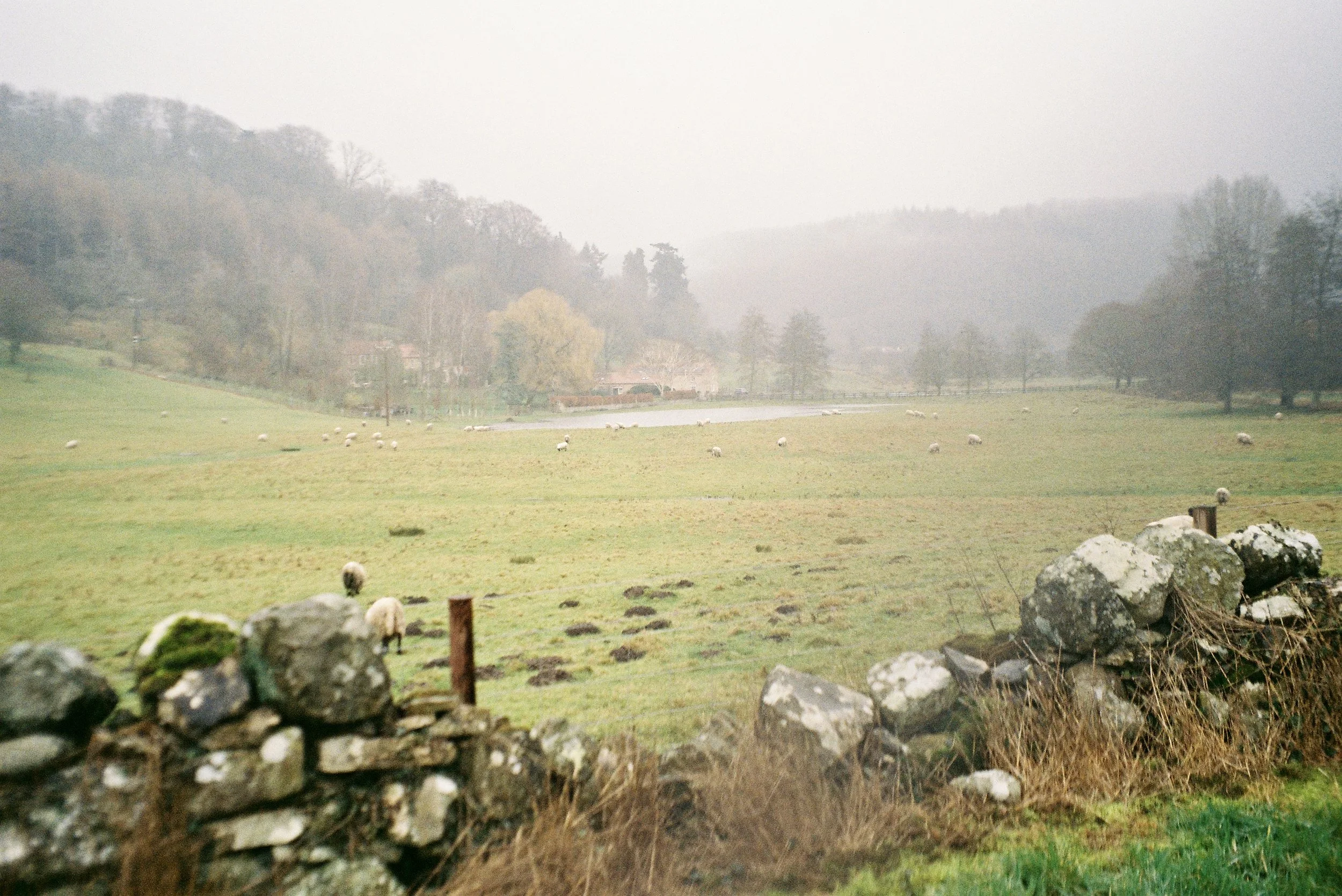
My constant companion through these expeditions, the ever-present FM radio, twitters on this morning, full of calls for the Prime Minister to resign, continued floods across the South West, and 19 days without sunshine. All pretty standard for a British February then, really. Apparently, it has rained every single day of 2026 so far, “no end in sight” laments the weather reporter as I crest the edge of Yorkshire’s other great expanse of rolling hills, the Dales.
Where the Moors offer up unyielding gorse-thickened heathland, the Dales bring a more rugged, if more commonly cultivated, landscape. Greater heights and sharper falls characterise their sweeping hills, though to me they seem just as sullen, sodden and fog-doused as all the rest. The only noticeable difference thus far: a few more bored livestock grazing what little grass remains in the swamped fields.
Margot Robbie is on the radio promoting her new film, aptly for my purposes an adaptation of Bronte’s Wuthering Heights, which has so far provided the descriptive narration for my journey through the Ridings. The film’s not for me, I don’t think. Described as “racy and inspired” by Margot – and “smooth brained” by critics – it does, however, kick up a particularly serendipitous segment of breakfast radio, Catherine Earnshaw’s “Wuther Report”.
“A high likelihood of turbulent howling winds, with gusts of lustfulness and torment as night falls” — check, check, check — minus the lustfulness, I guess; last night’s tagine wasn’t quite that moving, though today’s luncheon feast may well prove to be. “Don’t forget to bring your umbrellas as unyielding and mournful cloud coverage is expected to pass over the Yorkshire Moors,” — not sure what she means by “pass over”; consume might be closer to the mark on this one — “which will turn into a regretful rain. Some clear spells can be expected, though they will be fleeting…”. Fleeting clear spells would be a welcome addition, my window wipers working overtime to clear the water attacking from both directions: down from the leaden skies and up from the racing torrents sprayed off the tyres of a lumbering livestock lorry ahead.
I break free of the lorry’s wake and make headway down farm lanes and 60mph “A-roads” scarcely wide enough for my little motor, not to mention the tractors which peek out from behind hedges here and there. I dread to think what may happen if I come across anything coming the other way, be it motorised or walking upon four cloven hooves. Soon enough I’m out of the fields and into the forest, the gathering trees growing thicker and the low light afforded by the weakest winter sun growing ever duller as I venture deeper into their midst. Forests heavy with mystery and magic, and soon I find myself in the shadow of medieval royalty: the remnants of Knaresborough Castle perched atop a tumbling crag, glimpsed in snatches through the lazy mist.
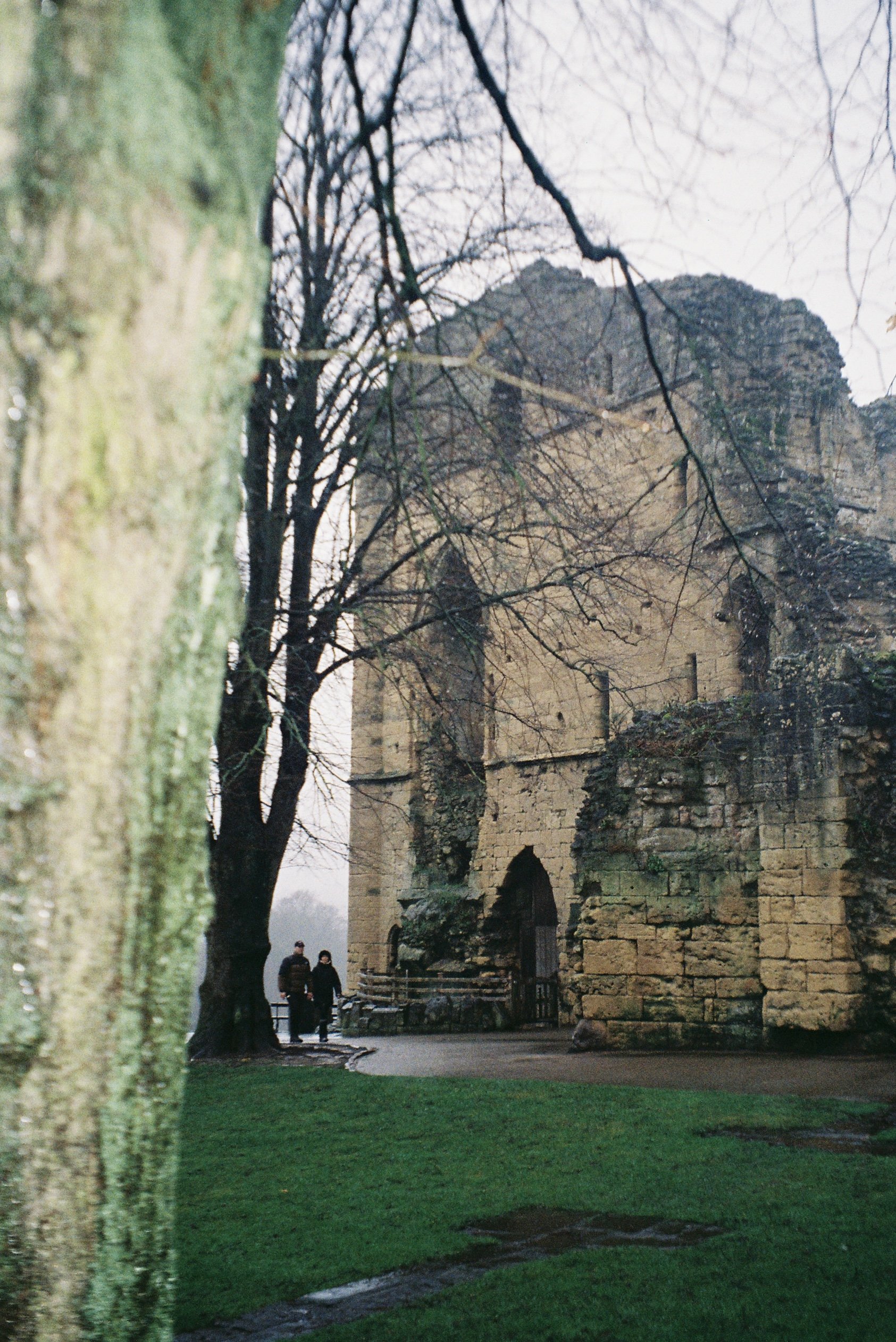
Moss grows on all the dark, wet stones, giving the ‘King’s Tower’ ruins a faintly green hue which glows in the low light. Built in the 14th century as a castle retreat for Edward II to use during hunting expeditions in the surrounding game-thick royal forests, there’s nothing much left above ground; only the crumbling walls of the eponymous tower rising from the cliff’s edge. The truly stunning remains lie below ground in the vaulted dungeons, sealed away under lock and key.
I catch a glimpse, through the forest falling away down the hill, of the town far below on the river’s edge, the sounds of the River Nidd rushing in the gorge below the echoing backing track to my solitude. Deciding to take a closer look, I walk out to the boundary of the castle plateau. Gazing out from between the vestiges of the old outer wall, I finally catch sight of the full force of the river crashing in a torrent of white rapids tinged with muddy brown far, far below. It falls in tearing sections down the weir, the broken stumps and trunks of trees strewn along the water’s edge — evidence of where the Nidd’s mighty power has broken the shackles of its banks.
To my right, the famous viaduct spans the Nidd Gorge, black stone towering over the placid surface of the dark waters upstream. Some of the road below, passing beneath the looming arches, is fenced off by luminescent barriers where chunks of the masonry have fallen from the superstructure high above, rail services suspended while they assess the damage and integrity of the 19th-century engineering marvel. It’s a fair investigation; the valley has a history of engineering catastrophe. The original viaduct collapsed into the flow of the Nidd below on 11th March 1848, just weeks before it was scheduled for completion, though its successor has stood strong in its place for over 175 years since.
I round the edge of the castle walls and begin a trudge down through the moat and forest to the riverbank far below, determined to sample the Goliath scale of the viaduct from beneath its feet. But, stopping to look up, I’m struck by vivid images of the dominant structure above me — the strength of these broken walls and the wrecked drawbridge — in the power of its heyday, and my determination crumbles. How impenetrable it must have been, what a force to be reckoned with; its very presence must have kept the surrounding population in check even when its master was far away in the White Tower in London rather than at play in the surrounding forest. Stopped in my tracks, it sinks into my internal reasoning that, if I continue with my walk down, I will be faced with a parallel walk back up — an unenviable task on a bright summer’s day, let alone in the skin-tingling cold of deepest winter.
A decision must be made, a decision reached in but an instant. I choose to retire to the cosy comforts of a little café and the warming capabilities of a strong Yorkshire tea. Number Thirteen Castlegate — the common ‘-gate’ suffix found throughout street naming conventions of Yorkshire, an anglicisation of the Viking ‘-gata’, meaning ‘street’ — welcomes me with open arms and a bright smile. My glasses fogging at the sudden change of atmosphere, I find myself a seat among the eclectic displays of spoons which line the walls.
Patrons roll in and out as I nurse my cuppa; I can tell this is a proper locals’ spot. Great relationships have been forged, kept aflame and rekindled here - of that I am sure from the conversations I overhear (eavesdrop on). Everyone knows each other within these walls, without fail offering me a friendly glance just to confirm I am the stranger I seem. My stomach rumbles from beneath my knitted layers — audible to me alone, I pray — so many options reach out for my starving attention. “Giant Crumpet” with salted local butter — “yes please” — but I must stay strong and hold my urges in check, for I have a massive culinary undertaking ahead of me.
The village posty stamps in through the misted door, his arrival jingling the bell above and drawing my attention away from the assortment of dolls and teddies along a bookshelf. Scantily clad in a daring pair of shorts falling to rest well above his knees — the white hair so thick on his lower legs he must be more than adequately insulated — he orders marmalade on toast, and I’m sure I catch a wry smile and twinkle of black button eyes from the Paddington in the corner.
Finishing up, I set my GPS to take the scenic route to my star-studded destination, and I plunge off Knaresborough’s high castle crag back down into the drowned farm lanes which bisect swamped fields. Again, I’m swept up along tight farm trails slick with treacherous mud and floodwater, farmers clad in the ubiquitous uniform of green with knee-high wellies, flat cap and collie at their heel nod in gruff acceptance of my presence in their realm. “Silly city slicker,” I can almost hear their scorn, as I tackle the terrain fit now only for the native 4x4s.
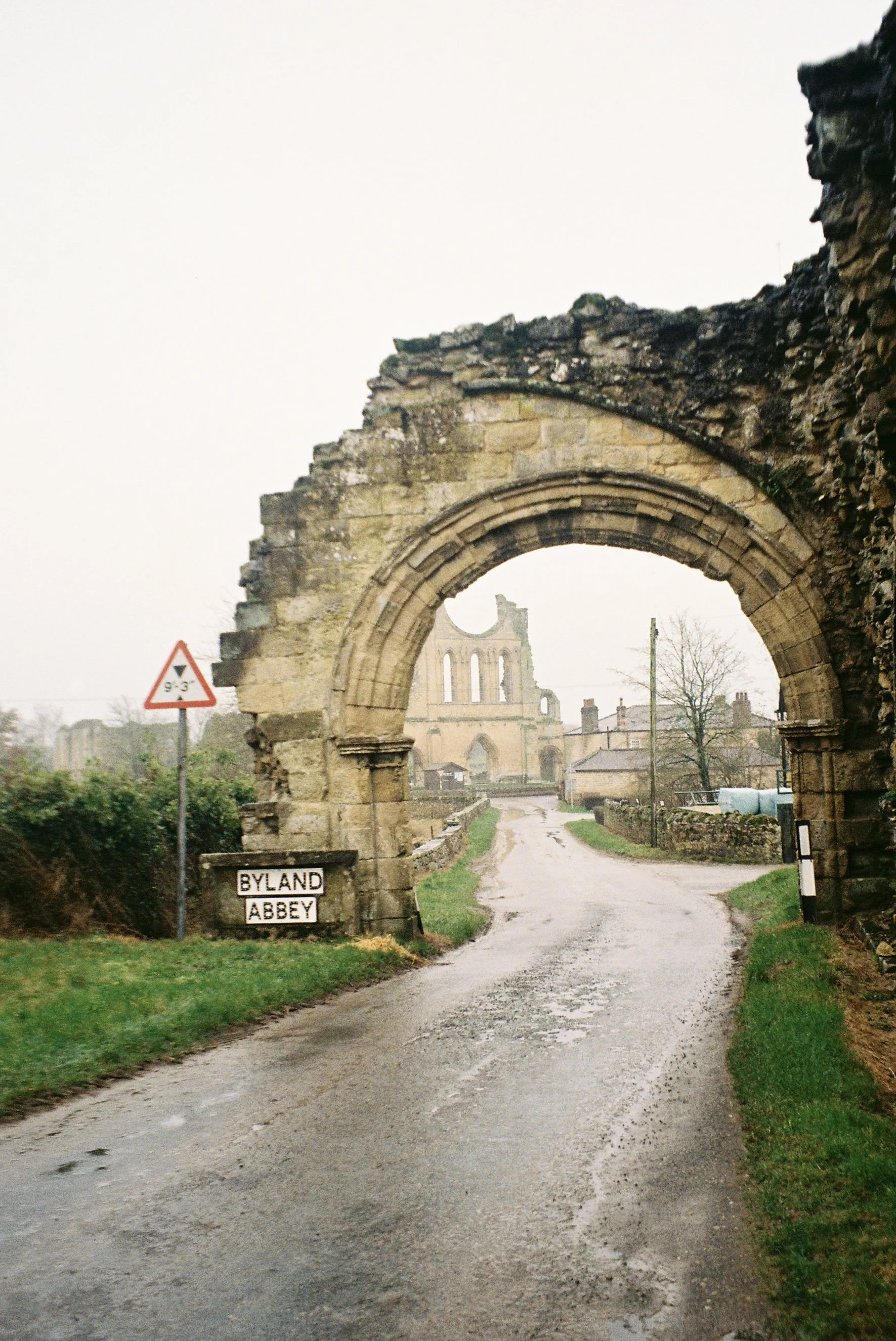
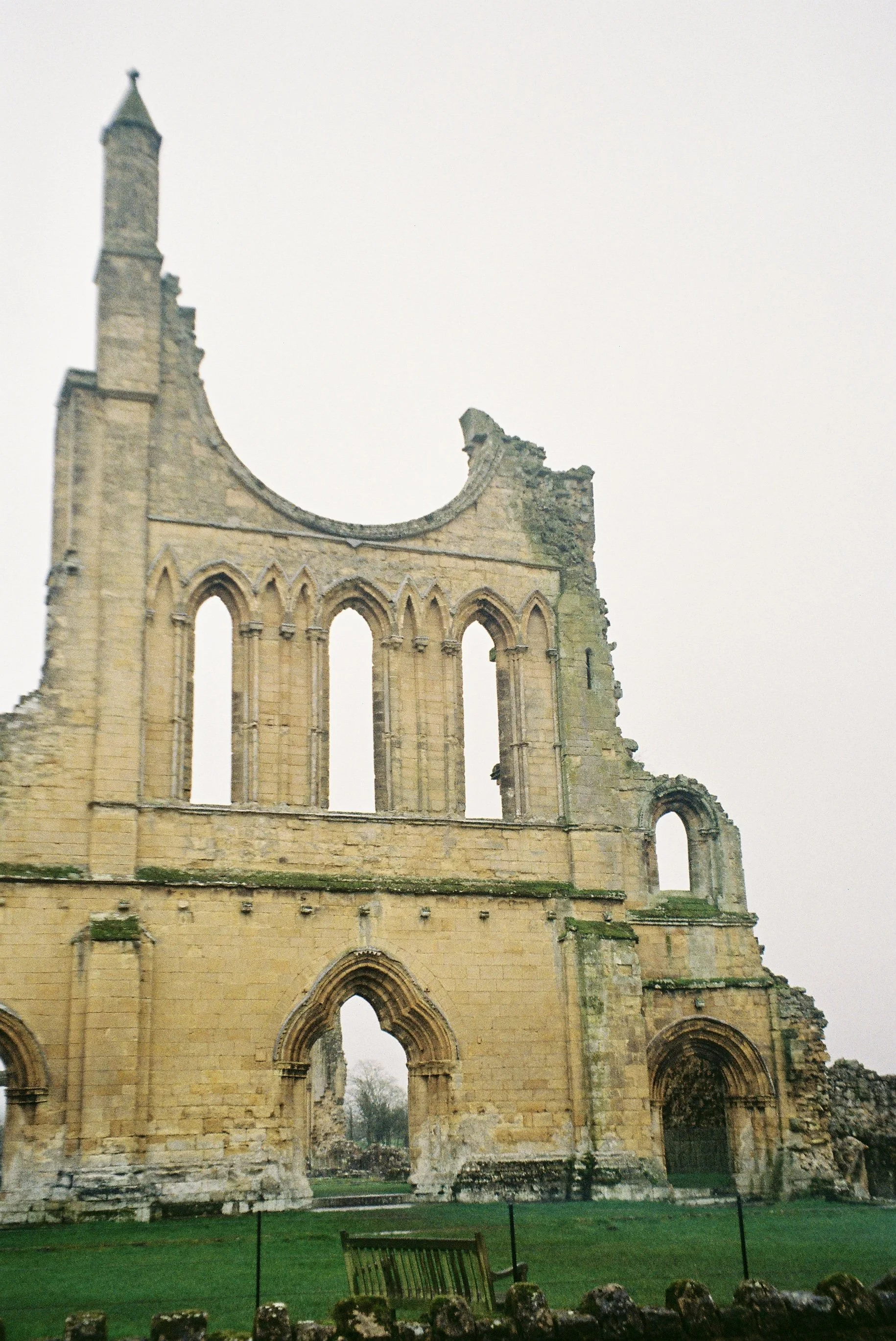
Out of the blue – or grey, as it happens - the broken remains of an old monastic archway crash over the road ahead, built right into an adjacent farmyard — in fact, it is the farmyard which is built out of it — through the crumbling stonework the stunning skeleton of a Cistercian abbey rises out of waterlogged fields. Byland Abbey is absolutely massive, larger than many of its contemporaries, including the famous abbey at Whitby, whose walls barred my entry yesterday, and having the whole place completely to myself more than makes up for the disappointment borne on that wind-battered cliff top. The residual crescent crowning the grand entranceway hints at the monumental stained-glass centrepiece window which must have graced these walls. Facing westward to catch the final rays of the setting sun in multi-coloured splendour, to fall among the monastic brothers at evening prayer, today those rays fall unadorned on the shimmering surface of swamped grass. How it once must have rivalled that famous Rose Window of York Minster, which it inspired. I would have loved to have seen it whole in all its glory.
I take my time walking silently among the completely saturated grounds, sheltered from the wind by the colossal walls rising from the earth. I’m able to faintly picture the abbey in its 12th-century grandeur as I hop from flagstone to fallen masonry, trying not to get bogged down in the gluttonous mud between. All I can hear is the bleating neighbours and the yapping bark of their canine chaperone in response, but that is all. No wind. No hymns. No call to prayer, or the hushed ecclesiastical conversations of the brothers who populated these halls in a bygone time.
Walking the outer walls, I stumble across a huge ammonite fossil coiling into the rockface and stop a moment to trace the ridges of its shell with my fingers. Four hundred million years old, this remnant of Earth’s incomprehensible past puts this great ruin into true perspective — if we were to shrink the history of this fossil down from its 400 million years to just 100, it would only have been in place here in the walls of Byland Abbey for a mere hour and twenty minutes, not even long enough to watch Arsenal throw away yet another lead.
The loud rumble of my stomach angrily bemoans my continued diversions and sends me packing back to the car. Rising out of the swamped Byland Valley, we climb through ancient woodland and back into the clouds of the Dales, my impudent gut leading the way, pulled on uncontrollably by the mouth-watering prospect ahead.
