Chapter Two. (Part Two.)
Yorkshire.
Landscape & Endurance.
The Moors & Whitby.
Upon setting my GPS, the sheer volume of driving I’m going to have to undertake brings into stark reality just how large this proud region truly is. No wonder I often see social media posts galore around major sporting events theorising how well a Yorkshire national team might perform at the football World Cup – pretty well, looking at the lineup – or where the White Rose nation would rank in the Olympics – 12th at the 2012 Games, above Australia, Japan and Brazil.
The county is massive, spanning well over 15,000 km²; it would not be classified as a micro-nation – it would dwarf Monaco, Andorra, Malta and the like. In fact, it would rank as one of the largest “small nations” in Europe, larger than Montenegro and Cyprus, and closest in population to Norway, Denmark and Ireland.
My naïve expectation to really get to grips with these storied hills in just two short days begins to feel less and less plausible – if it ever truly was – but I’ll give it a good go. I can’t help but feel a pull in my gut towards the winding roads ahead of me, a feeling of pure magnetism drawing me into the bleak hills forming the journey before me.
Starting up the car, I pull out of the ancient streets of York, past the walls which separate old from new and on into the hills and moors which make this region so famous. Hills which have inspired countless tales and birthed so many figures, fictional and historical alike, who have shaped the British consciousness.
I begin to flit past road signs and town names which call out and beg me to alter course, turn down that country lane and take the time to stop and explore, take the road less travelled and let the unworn path lead my journey of inquiry through the Ridings. High and Low Marishes, Pickering – of Ronnie infamy – and Stamford Bridge of 1066 fame all entice me with the stories they could tell and sights they may well hold close to their hearts.
In that latter village, where the Viking Age came to its end, is that fated bridge still there where one lone berserker halted Harold Godwinson’s army in a spree of butchery, writing himself into the legendary sagas as the final great warrior destined for Valhalla? I will never know – well, not this time around – for Whitby calls me on.
I know I am truly in another land from my own when I pass by a sign advertising not the next local football match, but the next instalment of “ploughing matches” against the neighbouring village. Go forth and plough them straight and true, young farmers of the Northern Ridings.
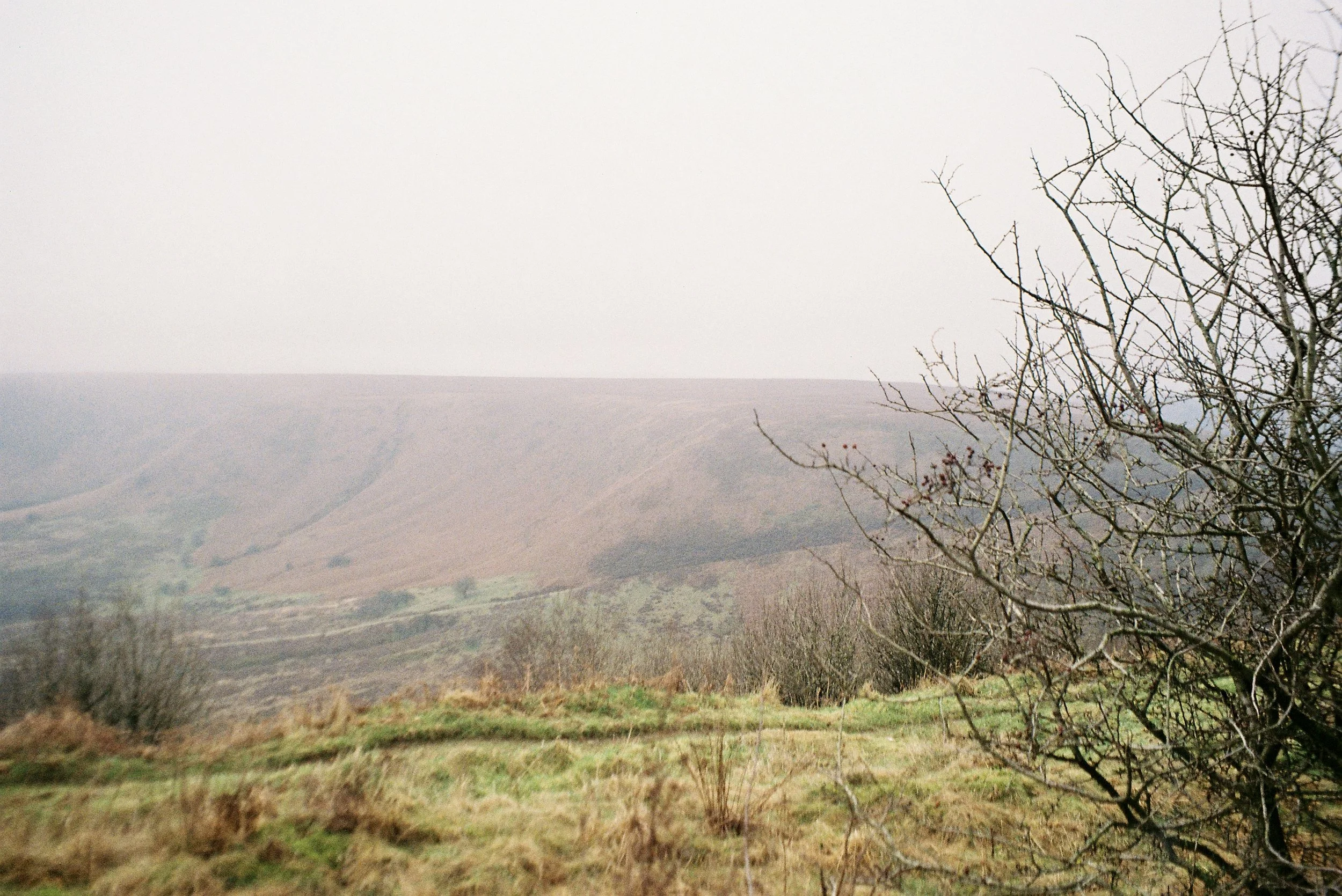
Up, over and through the undulating fields which populate the Yorkshire countryside, to my left and right I pass by fields caught in rare moments of sunshine, reminiscent of the rolling green fields that backdrop my classic Windows desktop. But as the gathering wisps of mist filter in at the edges, those same fields turn otherworldly in an instant. Without quite becoming aware of it, these cultivated pastures melt away into the fog to be replaced by gorse-thickened moors stretching as far as the eye can see.
The landscape is so bare of structures and features that it’s possible to see the approaching weather front as it draws ever closer, rolling over peaks and rushing up from the valley floors. “The moors, stretching away on all sides, were one sea of billowy mist”: Brontë captures the scene unfolding ahead of me in Mr Lockwood’s narration of the all-encompassing moors surrounding the grounds of Wuthering Heights.
I’m in no doubt as to how the atmosphere of this landscape inspired her tale of isolation, wild freedom and the destructive force of unrestrained emotion. The endurance needed to weather the uninhibited power of nature felt on these hills is preternatural and sure to send a character loopy. I certainly could not survive it; a brief excursion into its depths is all I feel capable of undertaking.
The sun drifts in and out of vision, a perfect bright white orb cut in razor-sharp outline by the rolling cloud, offering no warmth to the unnatural landscape which dominates the world around me. I “…shot direct across the moor, rolling over banks, and wading through marshes”, just as Lady Isabella Linton does in her desperate attempt to escape the confines of marriage to Heathcliff in Wuthering Heights. Across the moor I roll, down into the depths of the valleys, rumbling over little stone bridges spanning swollen streams since before Brontë’s day, the watercourses turning the land into shimmering marsh along each bank.
Out of the mist, in the chalice of sky between two rising crags, I spot frothing white surf breaking up the unrelenting gorse, the begotten shape of a ruin stripped straight from myth looming at the precipice of one of the cliffs. As I draw ever nearer, through the aptly named stone-grey town of Sleights, Whitby Abbey rises Harrenhal-esque over the landscape, the granite-grey sky swirling with rain-heavy seams visible through each and every shattered opening.
Lost among the sloping hills and narrow lanes, it takes an age to wind my way down through the town to the marina, passing the same buildings over and over, swinging increasingly familiar roundabouts, chancing a different exit with each revolution. Finally locating my berth, I’m more than eager to set out along the quayside and explore what this oft-forgotten seaside town has to offer. Tucked away as it is behind the seemingly impenetrable depths of North Yorkshire’s Moors and open to the ever-raging power of the North Sea gales, Whitby feels set apart from its coastal counterparts.
Most holidaymakers seek the easy route and scoot south of Brontë’s hills to England’s original seaside resort, Scarborough, but in doing so they miss the wonders of this fishing village come boom town and the original character of coastal life, unsullied by the faded gloss of Victorian vacationing. While so many seaside towns across the land fall into morose disrepair in the ghostly shadow of their heyday, Whitby seems to thrive in the shadow of its past, the same shadow that draws day-trippers from far and wide, even on a day as spectacularly bleak as the one which heralds my arrival.
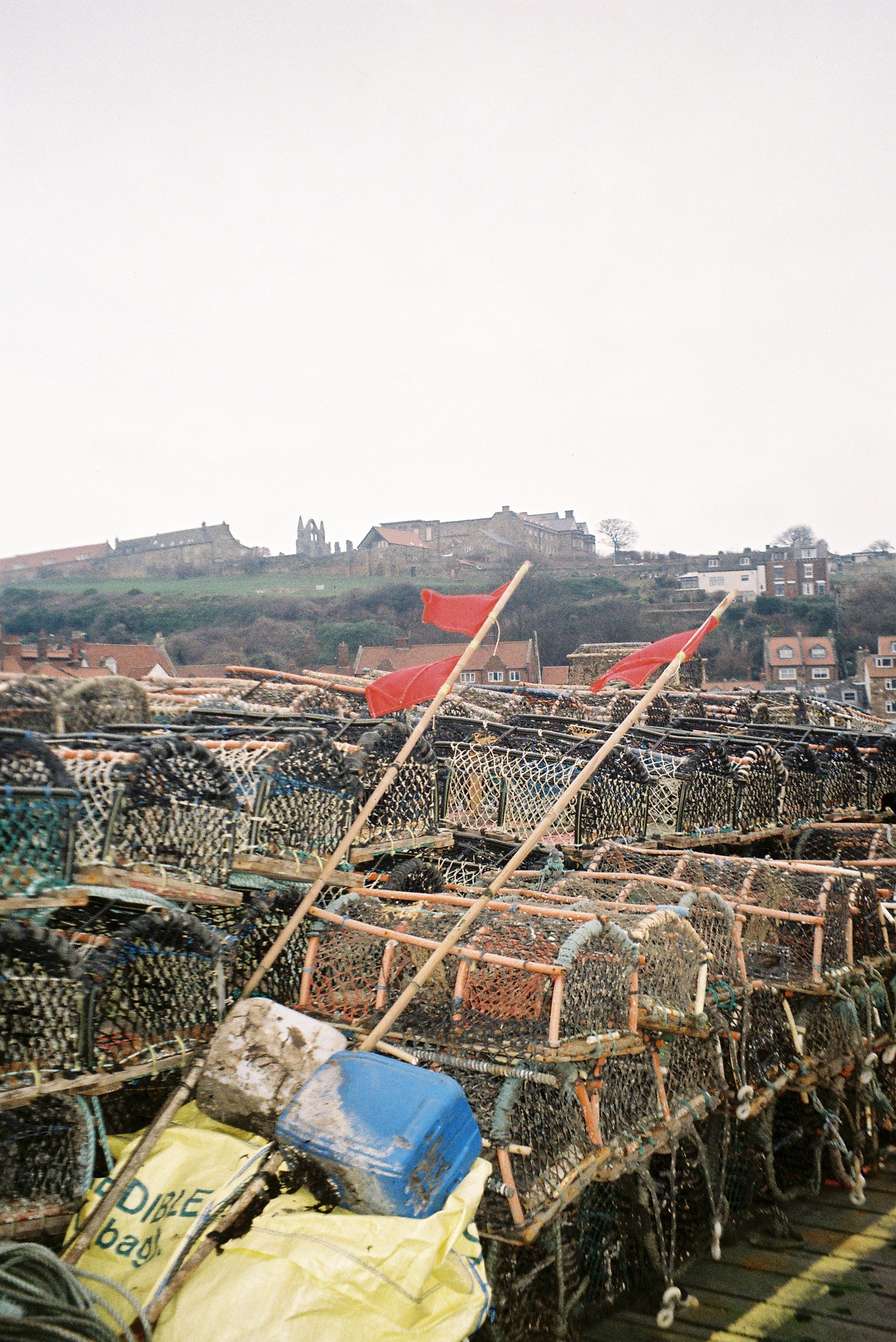
As I wander the harbour walls, the cry of circling gulls the soundtrack to my stroll, I pass by the forest of masts piercing the vista across the River Esk which cuts the town in two on its path to the sea, the buildings on either side cascading down in waves to its banks. Pleasure craft and trawlers alike moored for the night along the marina, waiting for the calmer seas of warmer seasons or simply the call of the next morning’s working day, come what weather may. Wafting through the air, I’m caught in my step by the reeking salt tang of the sea and fresh catch; a veritable mountain of still dripping lobster pots lines the harbourside, red flags fluttering from buoys pinpointing the netted crustacean-covered shells.
This is no simple pleasure port but a working town, specialised in its catch of shellfish. The fleet doubtless smaller today than in centuries gone by but focused now on inshore sustainability rather than the willy nilly trawling of the North Sea and Dogger Bank.
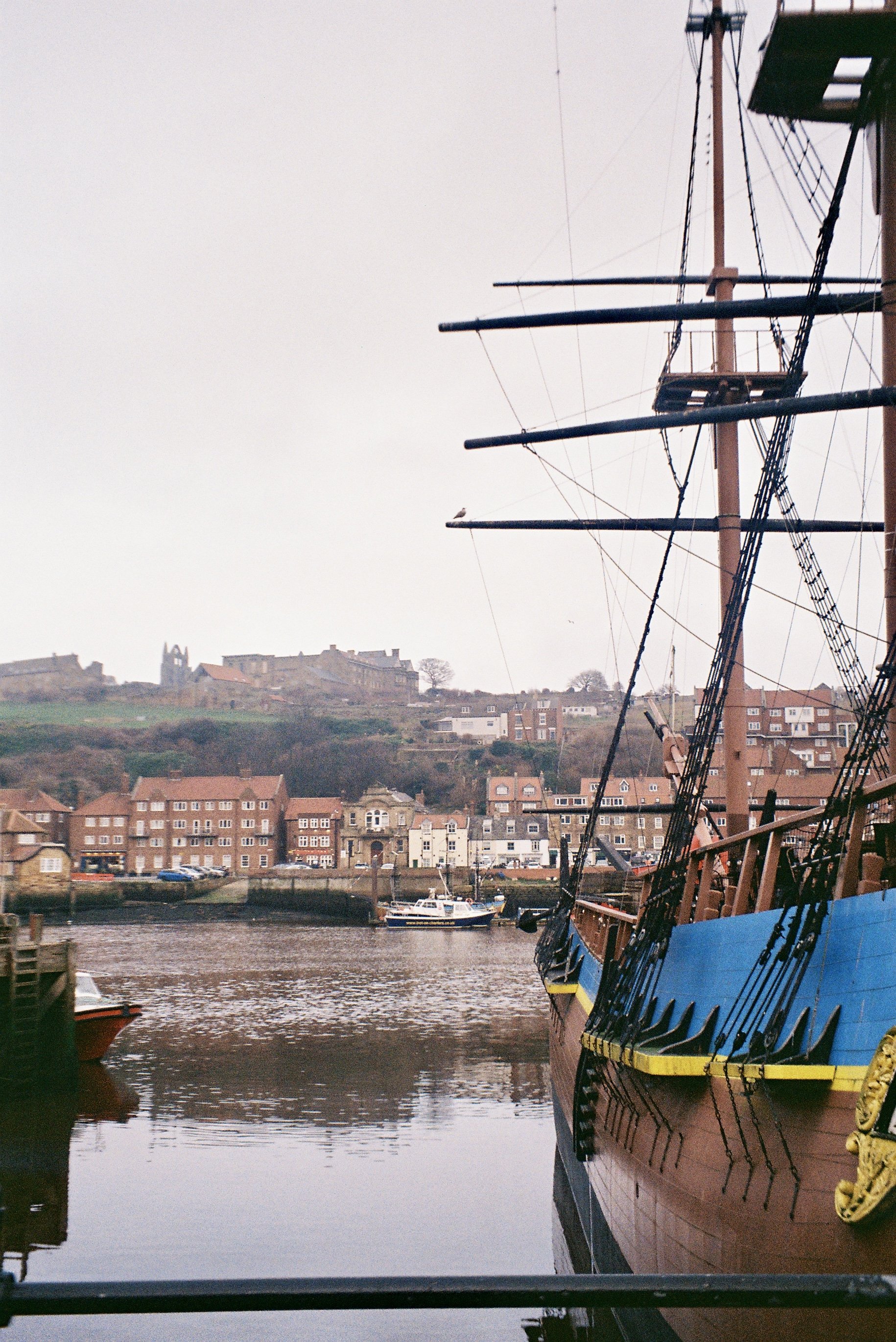
One vessel stands apart, hulking in its form, dwarfing the yachts and fish tugs with its rising hull, complete with towering masts and crow’s nest. This is a ship more than worthy of its chapter in the great history of the high seas and Britain’s leading part in that story. The great HMS Endeavour, commanded by Captain James Cook, the navy ship which carried him across the globe on his Pacific adventures, now sits here before me at this unassuming harbourside – in truth this is a gaudy replica, painted all to freshly for my liking, which has been converted into a tacky bar and restaurant. A true shame, really. The original craft was sold on its return to these shores and renamed the Lord Sandwich; its final resting place by most accounts lies somewhere off Newport, Rhode Island. But for my purposes, this replica will have to suffice.
Mighty in its role in world history rather than its stature, in many ways I may not be here today had it not been for this ship and the geographical triumphs of its crew and captain.
A proud Yorkshireman, it was here in Whitby that Cook apprenticed in his destined profession as a seaman, an undertaking which would lead him to the furthest reaches of this vast rock we inhabit. In April 1770, Cook, the Endeavour and its 90 crewmen became the first recorded Europeans to reach the east coast of Australia, arriving at Botany Bay just a few miles south of modern Sydney Harbour and its world famous bridge and opera house, when all around was simple rainforest and the fishing villages of the native Gweagal and Kameygal peoples of the Dharawal Nation.
But it was the momentous discovery which preceded his Aussie adventure which, in many ways, opened the path for my own lineage to coalesce. Six months prior to his arrival on the Great Southern Continent, Cook became the first Pākehā – white man – to make landfall on Aotearoa – New Zealand – since Abel Tasman’s brief excursion 127 years earlier, when the crew of the Endeavour came ashore at Tūranganui-a-Kiwa in search of supplies to continue his circumnavigation and charting of both the north and south islands.
The meeting of Cook and the native Ngāti Oneone tribe did not spell an auspicious start for relations between Europeans and the Māori people. Many accounts recall the Ngāti Oneone greeting the Pākehā with a ceremonial challenge – a haka – which the crew mistook for an act of aggression – understandable, really – shooting and killing Te Maro, one of the tribal leaders. Further meetings with the tribe and its neighbours led to mixed results: further deaths and greater complications, leading Cook to remark the bay “afforded us no one thing we wanted”, earning it the moniker ‘Poverty Bay’, which stands to this day on most maps of Aotearoa.
Despite this inauspicious start to relations between the British Crown and the Māori people – troubled relations which continue to this day – Cooks landing on the eastern shores of the North Island opened the pathway for the intertwining of European heritage and Māori Whakapapa which gave life to my mother and my ancestors, who hail from the very same region. Had Cook landed instead on the northern shores of the Eastern Cape, at my Iwi’s home town of Ōpōtiki, history may have panned out differently in those rolling winds caused by the flutter of a butterfly. Perhaps he may have met an earlier end than that afforded to him by the native Kānaka Maoli of Hawai’i, maybe he was scared away by the smoking crater of the volcanic Whakaari - White Island - which bubbles away off its shore.
My immobile moments recounting the escapades of Cook, his crew and the great Endeavour have left me shivering in the mizzle, enduring conditions more akin to his third voyage in search of the Northwest Passage through the Arctic than his expeditions through the tropic South Pacific. It’s funny to feel so conflicted about a man you’ve never met, and have only the slightest impression of, what little elements of their true character you do know captured only in writing which can always be skewed in the penning. On the one hand I can’t help but be awe struck by his great swathes of exploration and the avenues they opened up for the globalisation of the world. Whilst on the other, it is hard to ignore the great loss of cultures brought about by those same discoveries and the stacked negatives of that same globalisation. I’ve never been good at weighing up pros and cons, always attracted, like a bundle of electrons, to the positives.
The ship’s nautically themed restaurant is closed today, like so many others here, so far out of tourist season. Across the water from his ship, likewise shut to winter visitors, lies the Cook Memorial Museum housed in the cramped bunkhouse where the apprentices lived whilst learning their craft here in Whitby. But although my goal lies across the water, I am destined for a structure of more monumental proportions.
Crossing over Whitby’s century-old swing bridge, I pass by a tangle of metal wire shaped into the silvered spectre of a fishwife forever selling her husband’s wares by the quayside. At the far end the phantom ‘bridgender’ – an off-duty fisherman – stands sentry, gazing out over the gathered fleet at dock through the hanging wisps of low cloud.
Opening my gate, I begin a gradual climb up through the aged streets lined with sweet shoppes a plenty, windows piled high with pyramids of Whitby Rock. Fish and chip shops dotted on every street corner, though most are closed or closing already in the fading daylight, the pub windows I pass by dark, their snug interiors closed off to the sullen world outside as I tackle the ever-steepening incline.
Around the final bend of Church Street, the task panning out before me brings my faltering advance to a screeching halt. The crazy cobbled slope of Church Lane ahead looks as if the hand of the North Sea winds has pushed a great wall of stone to lie, not quite flat but, perfectly intact at a dizzying 50-degree angle. The slope before me gallantly tackled by a giggling couple arm in arm, gingerly shifting their way down the damp stonework. “Let’s use the stairs” she begs, but he is determined. “We’ve come this far – look, we’re almost there.” Famous last words. A little slip of his foot almost sends the pair tobogganing down the street and into the harbour below. Much to his chagrin, humble defeat is accepted and a hasty retreat beaten to the steps for the final feet.
My mind made up, I’ll tackle the 199 steps – could’ve fabricated just one more but ho hum – time for the burn. I’m in need of a proper workout, and this one comes with a view at the end.
Huffing and puffing, I crest the ridge onto the East Cliff plateau to be met by the sombre sight of St Mary’s church cemetery, perched here overlooking the mist wreathed town and the foaming surf below. Most of the tombstones I pass by are almost completely unreadable, so worn have they become by the unrelenting power of the gales which batter this headland. Those same gales push my body forcibly away from the cliff edge, before shifting course just as I right my equilibrium to send me tumbling headlong down the graveyard flagstones.
Stumbling upon an uninspiring yet standout headstone, I pause a moment to take in its face tipping top heavy towards the earth. A layer of damp moss carpets the top and the writing etched on its face is just about legible enough for me to make out the date. 12th February 1790, 236 years ago to the week that this Whitby gentleman passed on. His name gone, forever more a mystery rubbed smooth by the passage of those years. Regardless, I take a moment to remember this unknown father, son and brother of this Yorkshire coast.
Turning from my contemplation, I find myself faced with yet another sign of my incompetence. “Closed.” Again, my planning has lacked its cutting edge. Having climbed the 199 steps in the footsteps of Dracula and Captain Cook - and tripped up the remaining one - I will not be granted the opportunity to walk among the skeletal remains of the once great Whitby Abbey, the very grounds I have journeyed across the wraithlike moors for. The Abbey itself looms above me regardless, framed by the omnipresent background of leaden skies but, to be honest, this oppressive cheerless atmosphere seems the correct one in which to experience this setting. This moment unbefitting of a clear blue sky and a hot summer sun, the chill wind instead an apt companion to the broken dreams of Saint Hild, the 7th century abbess of the original monastery here.
A monastic presence has endured on this headland for over a millennium, though it’s faced a fluctuating journey of tremendous growth and devastating decline over those years. Abandoned in the 9th century thanks to the violent success of multiple Viking raids against the rich monastic orders, it was properly repopulated in the wake of the Norman conquest and reached its grandest peak in the 13th century.
The Benedictine abbey thrived here for hundreds of years, a centre of learning which drew monks from across Europe to study the Word. But, as with all the great monastic centres which graced the verdant fields of Yorkshire, it was ripped to shreds of its former glory by the all-encompassing dissolution of the monasteries by Henry VIII as he wrestled his Kingdom from the covetous grips of the Roman Catholic Church , and into the avaricious arms of his own Royal Church of England.
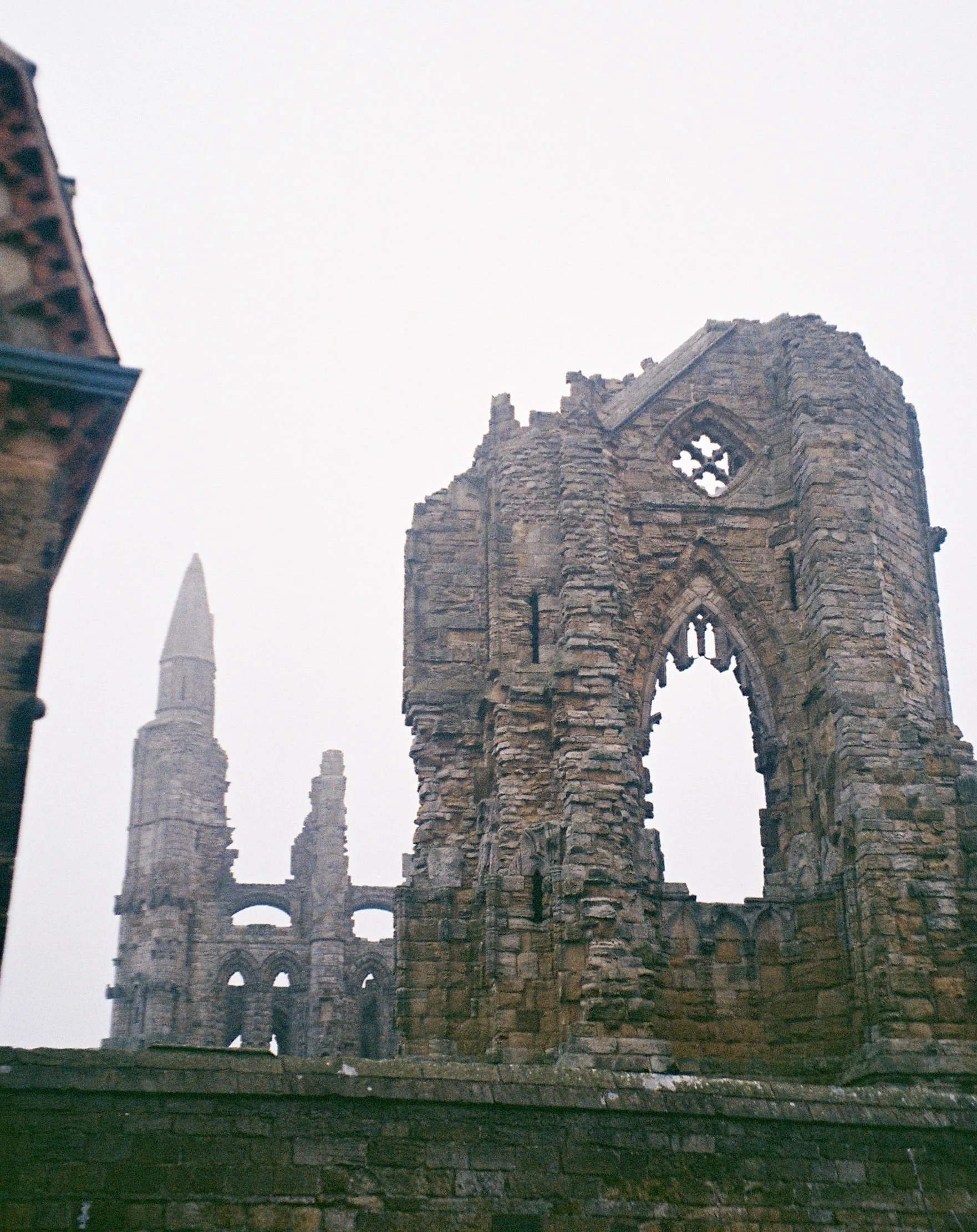
No matter. The great ruins rise high above the outer walls, and I must only crane my neck to take in much of what remains. The shattered West Front of the structure – destroyed most comprehensively by a German naval bombardment in 1914 – forms the ominous screaming visage of a one-eyed giant. Four gothic crosses create the one all seeing eye; the snapped housings of a once majestic stained-glass window the bloodthirsty fangs. It seems Polyphemus himself kneels broken atop this cliff, crying out his blind anger at Nobody across the “wine dark sea” which stretches out before us towards the continent out of sight.
Turning from the fractured monster, I hunker down against the outer wall and begin my circumnavigation of the grounds, hoping - against hope - to find myself a clearer picture of the once celebrated priory. But, the appearance of a winter mirage begins to condense through the shifting fog. It can’t be, can it? Whitby Brewery. I’m saved.
I throw off any endeavour to continue my battle against the elements, so fiercely fighting against my progress, and retire into the taproom for a swift half of their light golden Abbey Blonde. Seated on their up-cycled beer barrels beneath the vats of this hipster micro-brewery with its revolving hot stone pizza oven and graffitied tables, I ponder the revolutions of time. Beer has been brewed right here for hundreds of years, just as it still is today in the forbidding shadow of this ancient abbey. The pointed towers of the abbey’s East Front – the very silhouette which inspired Bram Stoker’s nightmarish vision of Dracula – loom dully against the darkening sky in the giant barn house window. I raise a glass to the brewers of old and the brewers of today. The beer is light and hoppy, with a crisp, zesty finish and a nice floral hint of Styrian Bobek hops. At least that’s what the website says, to me it is perfectly sinkable and well deserved - or so I tell myself - after my brave climb into the clouds.
I could stay here out of the cold for a long time, but the shadows are growing longer, the darkness drawing steadily in, so, nodding my thanks to the bearded beer master, I duck out into the moist air and set off back down to the bowels of Whitby town below. Somehow, against all desire, I’ve ended up taking that ill-fated slope down Church Lane. Remonstrating with myself for my foolishness, I take each step with almost comical caution, each cobble shining with a slippery sheen of moss and moisture.
So focused am I on the placement of each footstep that I almost fail to notice the mist oppressed hills. A wet rain falls in torrents as the other half of Whitby, out there over the Esk, has completely disappeared in the Sea Roke rolling in off the omnipotent Mare Germanicum.
Stumbling down the final steps, I retrace my path across the swing bridge and make my way along the quayside, hunkered down into my jacket collar, advancing against the oncoming wind towards the extremity of the West Pier. The streets this side of the river lined with classic British seaside attractions, Dracula experiences and summer holiday shops ready with their unicorn inflatables and jellybean bucket and spades.
I take a perch opposite the boathouse of the returning RNLI crew, uniformed in bright yellow waders, the team all hustling inside out of the chill for a well-earned brew. I wonder whether it is simply training they’re returning from, or whether they have been out there on the rough winter seas saving some poor soul stuck in the perilous currents beyond the safety of the breakwater.
Onwards. I’ve not drawn the short straw like the unfortunate crewman left out in the cold to spray down their bright tangerine machine. I spy, at the end of my winter day, the treat I have left for myself. Stopping in at the famous Magpie Café, I order a cheeky spot of pre-dinner dinner, opting for the mini—though not so mini—fish and chips, as I don’t quite know what awaits me when I reach my lodgings for this evening—though I’ve got a good idea. They’re feeders, my hosts for this night, and I love them dearly for it.
I’m directed to a seat upstairs by the window, though I had intended to take my seaside dinner away, wrapped up and sweating in vinegar, to the end of the pier to enjoy in the full-frontal spray of the sea air. But I am more than thankful my ill-advised plans have been waylaid as I gaze out over the Esk, the harbour, the twin East and West lighthouses, and the looming abbey ruins, all wreathed in rolling mist and driving rain. I can’t quite remember who told me to visit the Magpie, but I sorely wish I could, because at this very moment I want to wrap them in a tight embrace, kiss both cheeks, and thank them for the recommendation; the meal is fantastic.
Fabulously battered fish, crispy with a crazy crunch of a thousand scraggly crests thanks to the classic beef-dripping fry; perfect chip-shop chips crackling on the outside, fluffy white pillows within; and fish so fresh I can’t help but believe it must have been landed this morning from the boats moored alongside the posts outside. Some places are institutions for a reason, and a steady hand shapes the finest work. This culinary legend of the White Rose has been in the same family since the ’50s, their website proclaiming, “a trip to Whitby isn’t complete without a visit.” It has made mine—but now my trip here is over.
Not for the last time, I hope, I wave goodbye to this little bite of British seaside glory and drive out of Whitby, up into the darkness which has dropped like a sheet over the landscape. “The moon shone bright; but clouds drifted across it, throwing it alternately into shade and brilliant light,” before it disappeared altogether in the tyrannical rule of mist and fog. Driving over the moors earlier today was an eerie experience, but one I relished for its atmospheric qualities; driving in these ever-worsening conditions, in the pitch black of winter’s night, feels like a deadly and completely different undertaking entirely.
Now “there was no moon, and everything beneath lay in misty darkness,” my vision restricted to mere feet in front of my windscreen as I rise and fall in rollercoaster arcs over these once awe-inspiring hills. The scant light of my headlamps bouncing back at me, laughing from the soup-thick fog; oncoming cars apparate out of the gloom seemingly from nowhere, the monstrous glowing eyes of their headlights piercing through the horrible night like the hounds of Hades. Hands gripped around the steering wheel, my tight knuckles bone white, I drive on in silence, concentrating on the snaking road ahead, cresting a ridge here and there to break free from the oppressive cloud, only to be cruelly thrust back below its surface, gasping for breath into the murk once more.
What feels like an age later, I’m free. I turn my music loud in celebration, hustling now along the A-roads to make up some precious lost time, my salvation growing closer with every tire rotation. Arriving at my aunt and uncle’s in Leeds, I’m greeted with a warmth I’ve hardly had the chance to feel today, though throughout the chill I’ve loved every town.
A fabulous dinner awaits: slow cooked chicken tagine with sweet stewed apricot and preserved lemons enough to feed an army of worn-out wayfarers. But today it’s us alone who get the pleasure of this divine sustenance, shared between great company over flowing conversation. A cheeseboard and one or two too many glasses of Italian Cocci send me off to bed in a gentle fog so unlike that which has permeated my experiences today. Great experiences they have been, of a county best taken to heart in these conditions I feel - although perhaps that’s perhaps my romanticism coming to the fore once more. Perhaps the day may have flowed stress free in the summer sun, but I care not
Off to sleep, weary traveller, ready for tomorrow.
