Chapter Two. (Part One.)
Yorkshire.
Landscape & Endurance.
York.
My adventures of exploration through Yorkshire start ominously, foreshadowing the elemental force which will come to dominate my time in this proudest region of these United Kingdoms.
“If this truly is God’s own country,” I muse to myself, “He has a funny way of showing his love.”
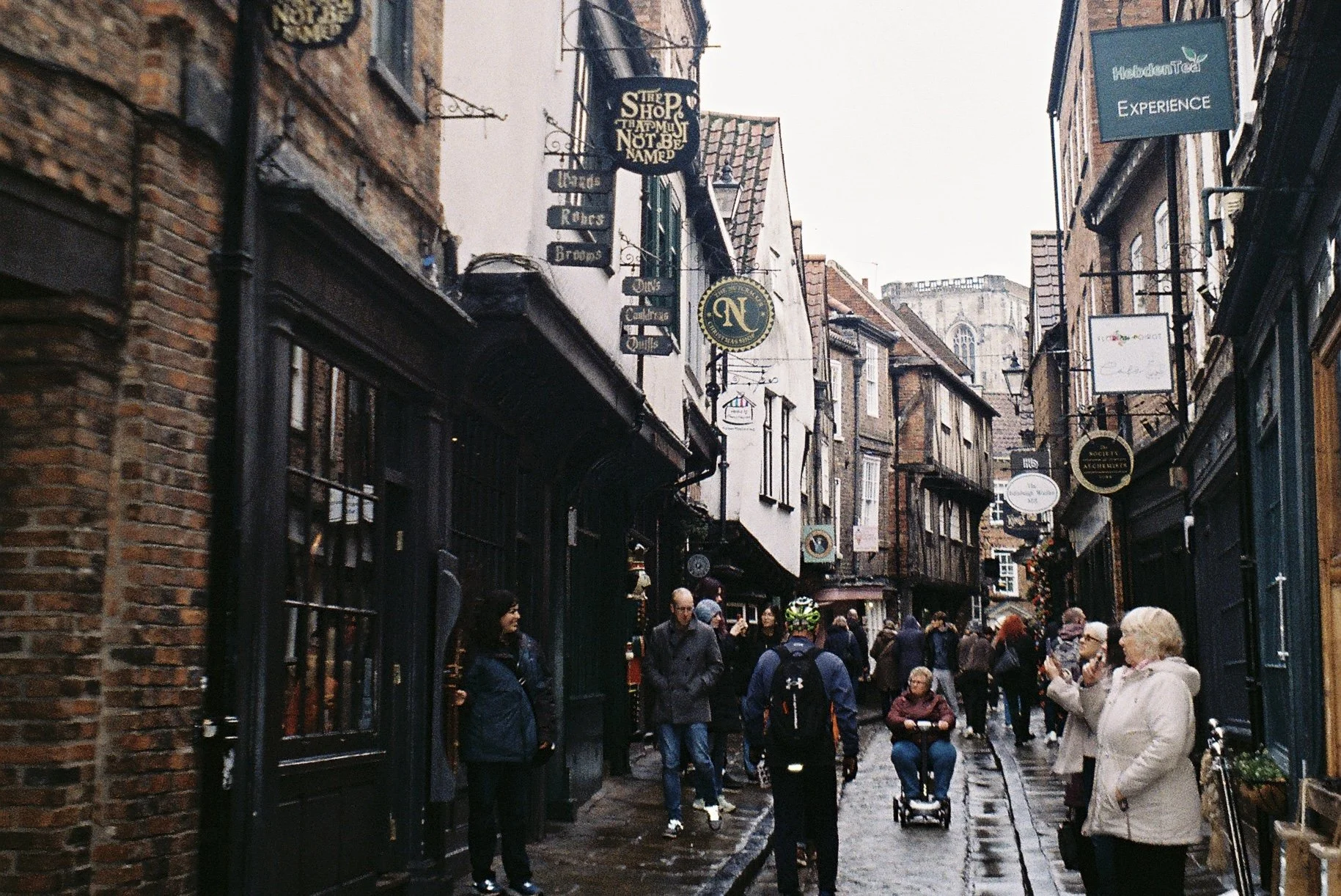
Standing right on the edge of York’s famous Shambles, I take hasty shelter from the all-encompassing mizzle which permeates the atmosphere of this archaic quarter of one of Britain’s most time-worn cities. Jogging down Whip-Ma-Whop-Ma-Gate (Neither-Here-Nor-There-Street) I scrunch my head down low in an attempt to minimise the effects of the lazily falling specks of moisture, neither rain nor mist, not quite either but somewhere in between.
I duck beneath an archway and into the narrow, covered alleyway tucked away behind St Crux Chapel, its walls bowed and leaning in the minimal light of the grey world beyond, shut out of this claustrophobic cloister. I take great solace, however, in the bright vision of indulgent salvation at the end of this particular tunnel.
The Shambles Kitchen can take great pride in its description as a happening hole in the wall. A queue has formed stretching around the corner, eager travellers and workwear-clad locals alike squished against the wall into the scant shelter of the overhanging guttering, waiting their turn to sample the famous wares of York’s smokehouse sandwich shop. It is my destiny to join this ambling mass of humanity. Sucked in and mind-numbed by virality, I must have my share.
I take my predestined place at the back next to one of the countless Harry Potter-themed shops that seem to litter the Shambles streets, The Shop That Must Not Be Named is pointedly aimed at the hordes of international visitors who have no reference of British life besides the bright lights of London Town, other than the boy who lived.
I finally take my place at the window, getting my first whiff of what’s to come; the spicy, sweet and savoury tang of wood smoked meat. I order myself a stacked ‘Harry Trotter’ pulled pork sandwich and I must clamp my mouth firmly shut to control my inner Homer Simpson begging to be set free.
The fresh focaccia parcel handed to me through the portal window is fit to burst with glistening hunks of shredded pork butt and slaw, which I pull close to my chest to shield from the pitter-pattering beads of water falling from the sloping roofs above. I spy my opportunity for a dry seat and scramble away through Saint Crux Passage into the tented coverings of Shambles Market beyond.
A veritable Shangri-La opens up before me, a hidden world of culinary delights tucked away from the crowded main street behind me. A plethora of little stalls offer foods from across the globe; hot dogs, Thai, Moroccan BBQ, fish & chips, Indian street food, smokehouse burritos and pick & mix your own apple crumble, all served with a smile and a thick Yorkshire accent.
I find a perch among the scattered family groups, wiping down the bench I can’t help but bemoan the depressing weather front that has been forced upon my journey. Nothing but rain since I set out from London this morning, and nothing but rain for the foreseeable future. It’s a tale as old as time here in the UK, but this time, for whatever reason, it seems all the more overpowering.
As I rattled along the M1 northbound I passed by great rivers and humble streams all broken free of the constraints of their banks, swelled to disproportionate levels swamping the adjacent fields which reflected the sky and shone like the surface of pearls broken only by the bare stalks of trees and hedgerows. It was to become a familiar sight in my journeys up and over, through and around the great Moors and Dales of the White Rose County.
The screeching roar of a patrolling fighter jet cutting the placid sky overhead rips me back to my surroundings. Caught completely off guard, I lean back in an attempt to catch a glimpse of this marvel of modern warfare, but only catch a face full of water droplets falling like Jericho trumpets for my trouble.
I have had the great pleasure of growing up directly beneath the bustling flight path of Heathrow Airport, and am not unfamiliar with the deafening rumble of Boeing 747s as they drop their wheels for the final moments before landing at five in the morning. But the otherworldly banshee cry of these warplanes is something else entirely, and I can’t help but be gripped by a childlike captivation at their sudden arrival in my vicinity.
Wiping my face, I’m fortunate enough to catch the final amusing looks thrown my way by the burrito ladies, who assure me “it’s alright pet, we’re not under attack. Just routine ‘round these parts.” Not that I was worried, obviously.
No more time for funny business. I think it might be time for me to attack my own target.
I zero in on the super-dreadnought in my crosshairs and prepare to unhinge my jaws anaconda style to really get to grips with the stack in front of me. Taking my first bite, I’m slapped into sharp reality by the unctuous hit of the smoked pulled pork, not overly sweet with sticky sauce like so many BBQ offerings. The flavour of the spiced meat really takes point while the sharp wingman tang of vinegar doused raw slaw cuts through the richness like tracer fire in the night sky.
I attack my objective in fits and starts between note-taking, but as I progress I begin to feel overwhelmed by a creeping sense of inadequacy. There’s no way I can finish this mammoth offering. Awful questions begin to swim through the meat-smoke screen gathering in my subconscious: surely they can’t always be this stacked? And if they are, I’d like to meet the man — or woman — mountain who can put them away and get on with their day after such a mission.
Alas, I make a valiant effort to vanquish my foe but must admit admirable defeat. I rise from my perch, nodding farewell to the stallholders of the market square I duck back through the archway into the medieval patchwork of wonky shops which make up the famous Shambles.
The black timber wood framed 14th century shopfronts which line this cobbled thoroughfare are tiny and positively pokey in comparison with the grand metallic and glass fronted halls of modern retail, but with that hodgepodge makeup comes a character which has been almost completely lost in 21st century architecture.
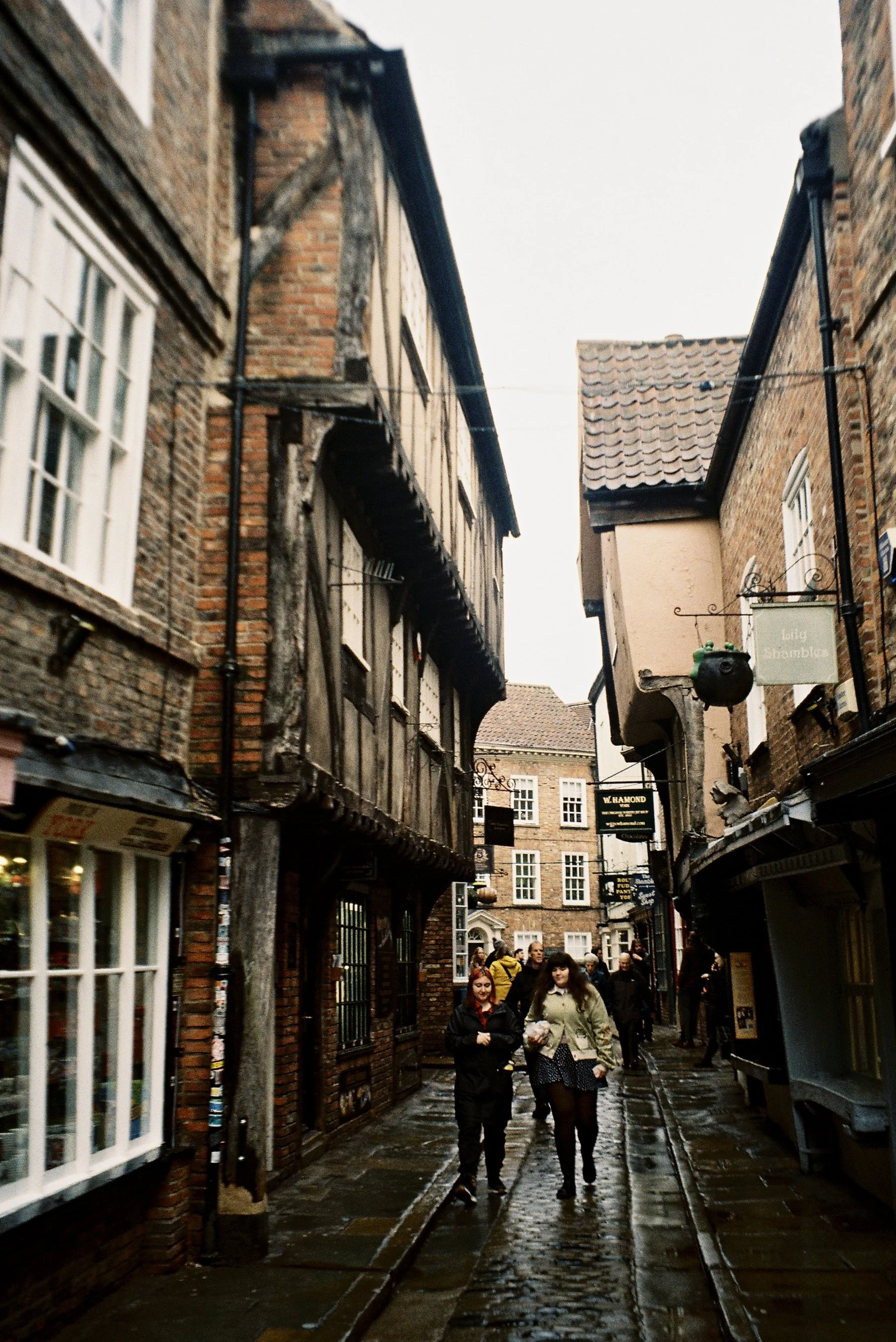
Every shop leans – metaphorically and physically – into the magical feel of the street. I wander up the alley dodging the outstretched selfie-sticks of Japanese tourists, past the top heavy and dimly lit Society of Alchemists selling its eaux de parfums displayed in glass bell jars held aloft by coiled bronze snakes and golden toadstools evoking the apothecary shops of Diagon Alley, the Wizarding World come to life.
I can’t help but feel as though I’ve wandered onto a prefabricated movie set, so perfect is the medieval world I’ve stepped into. I could easily be at Universal Studios waiting to ride the Hogwart’s Express with a creamy Butterbeer in hand. If only Orlando’s weather had come along for the ride.
To complete any sense of confusion as to the separation of fantasy and reality, a man garbed in archaic steampunk attire stands doorman outside a sunken shop front. His job, corralling a queue of eager customers waiting for their opportunity to purchase a kaleidoscopic range of ceramic ghosts and ghouls. Maybe I have stepped through the bricks after all.
But no, these streets are no gimmick, no fabrication. This reality hammered home for an overpoweringly obnoxious group (of unnamed cross Atlantic origins) by the huddle of three bacchanal boozers sat on a bench, happily guzzling vodka straight from the bottle and shouting at passers-by at midday on a Monday. That’ll put pay to any romantic idylls of mythical England they may harbour. If anything, it makes me feel a little bit more at home, and I have to suppress the skip in my step as I walk on by the shocked expressions which mask their previously wonderstruck features.
Above the narrowing upper floors of the lane rises York Minster, towering over the cobbled streets in a vista barely changed by the passage of time. Pilgrims, traders, rogues and knights of the realm alike have tramped these stones for hundreds of years and I, likewise, set my destination full speed ahead. No time, it seems, to stop at The York Roast Co. to sample the Shambles’ answer to a burrito – a roast dinner with all the trimmings wrapped up in a Yorkshire pudding. Do I regret my earlier culinary decision making? No, not really.
My trajectory is waylaid, however—as always—by the gravitational pull of a beautiful bookshop, its windows piled high with opportunities for literary delight. It’s a visceral fixation which I must curtail, but I won’t. I just don’t feel like it. The Minster Gate Bookshop offers a warm refuge from the pervading drizzle and chill of York’s ancient streets, its interior a low-lit, cluttered collection of primeval texts stacked to the rafters on shelves bowing with the great weight of knowledge their pages hold.
I’m greeted upon entry by the comforting nostalgic smell of bound pages; earthy and wooden, harking back to the very origins of these sheets of consciousness. An acidic twang lingers in the air from the slow decomposition of the older articles on offer, and a sweet note I can never quite put my finger on; is it vanilla, almond or maybe even a hint of rich cocoa at the back?
The front room seems to sway beneath a mass of Arthurian literature and tales of myth and legend from around the classical world. I lift Tolkien’s retelling of Beowulf’s saga from the shelf to take a closer look, but hesitate to do the same with a handsome volume filled with aged yellow, crumbling pages bound together in deep blood-maroon leather embossed with swirling Celtic knots. Its title Hero-Myths & Legends of the British Race calls with a siren song to my fascinations.
But I do not take the risk of lifting it from the security of its fellow aged tomes, boxing it in on either side like the hulking bodyguards of the rich and famous, I fear my clumsy touch may spell its destruction – and besides I’m on a self-inflicted book buying ban, so great has my pile of ‘to read’ titles grown.
I take the opportunity to defrost a little more and step on into the deeper recesses of this labyrinthine library, the plush red carpets sinking underfoot. I squeeze my way through spiralling corridors more suited to sober reverence than drunken perusal, down the tiny winding staircase I’m carried into a treasure trove of books, prints and paintings.
I linger for a long time in front of a print displaying the street layout within the old city walls of York as it must have been in the 15th century and marvel at how little it has all changed. Sure, some of the shops now carry contemporary names familiar throughout the land – the standout culprits BetFred and Greggs, housed incongruously in wonky wattle and daub – but in essence these byways remain as they have been for generations. To think the names and characters who must have traipsed along the cobbles, and now I must return to their footsteps. Brave the cold once more, weary traveller.
I tumble out of the narrow Shambles alleys into the grand open space in front of the monolithic south face of York Minster shining with the Midas touch of a rogue ray of sunshine piercing through the otherwise gunmetal grey skies. Unfortunately, that lonely ray has only the chance to shine on a minority of the bare Todcaster limestone which forms the Minster’s stunningly intricate carved superstructure. The Twin West Towers stand tall and proud, free of the scaffolding which wraps the rest. Builders in glowing high vis move busily along the gangplanks like a colony of ants working with providential intent to restore any time lost grandeur.
The iconic Rose Window above me is completely covered, shielded from public view in an attempt to restore it to its former beauty following fire damage sustained almost half a century ago, the works paid for by public admissions fees. A full twenty quid’s worth of admissions fees per entrant. I can’t help but shake my head in complete incomprehension, I reckon I’ll pass on the chance to see what marvels lie within these aged stones, but wish them luck in roping in the mindless swarms of tourists around me, busy snapping pictures regardless of the Minster’s plastic shawl.
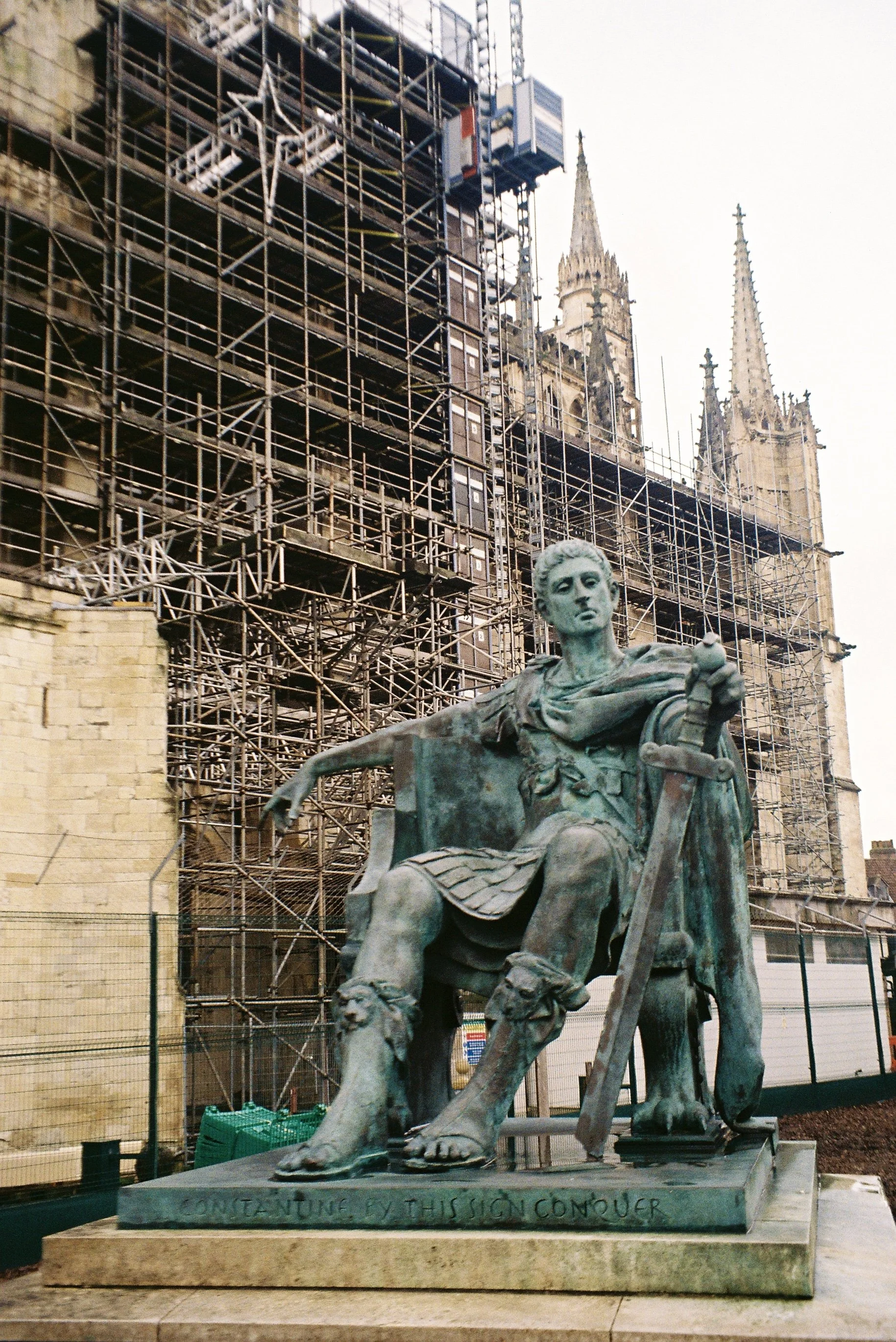
I’m drawn in predictable fashion to the copper statue of a Roman gentleman lounging imperiously in cape and cuirass upon a marble throne with lions’ claws for feet. At first I assume it must be dedicated to the 2nd century Emperor Septimius Severus, who once led a campaign of conquest on these isles with the ambition of finally quelling the Northern threat to Roman Britain and civilising the tribes of Caledonia beyond Hadrian’s Wall. Born in the Mediterranean shores of North Africa in Leptis Magna – modern day Libya – it was here in Eboracum – York – that he met his end after falling ill on campaign.
But I am mistaken – apologies, very shameful I know. Instead, I find myself face to face with another mighty son in the storied pages of Roman history and its lasting impact upon Europe and the world. It is Constantine the Great who gazes out magisterially from his throne out over his lands and subjects, a look of confident disdain covering his face, his hand resting on the pommel of the sword stabbed into the ground at his feet.
This Imperial Son was the first Roman Emperor to convert from the pantheon of Rome’s pagan gods to the Christian faith – and be canonised for the decision, nicely played good sir. Constantine was proclaimed emperor right here on the spot beneath my feet in the year 306 AD by his forces in Britannia, as he carried on the fight begun under his predecessor Severus against the Picts of Scotland — a contest destined to rumble on for century after century and still fought today, if only symbolically, the Calcutta Cup its prize.
Behind me a lone Roman column rises in the shadow of the Minster, raised now where it once stood in the headquarters of the Legio VI Victrix who garrisoned Eboracum in the days of old. It was unearthed during an excavation beneath the Minster in 1969 exactly where it had fallen centuries before. Today it stands testament to the layered tales these streets hold through the ages; Roman Eboracum, Anglo-Saxon Eoforwic, Viking Jorvik and finally modern York.
The deep rumbling toll of the Minster’s bell signifies my time in York is drawing to a premature conclusion before I have even had the chance to scratch the surface of this storied city. Resonating through my very being, the ringing means I must depart without having gazed upon Viking Jorvik’s most peculiar of finds, the famous Lloyd’s Bank Coprolite – look it up, I won’t sully these pages with its description. Still, I make peace with a city which has won me over in only a few limited hours of exploration. My opinion firmly shifted from its previous course. My only preceding experience of the city had been a childhood expedition to the York Dungeons, which had ended unceremoniously with the ruin of my brand-new beanie, an outcome I had thought could not be easily overcome. If you must know, I was forced to use it as a receptacle for epigastric regurgitation – that’s right, I chucked up in my Christmas present.
Instead, I have fallen in love with these jumbled lanes, jigsaw shops and mystical cobbles. As I set off retracing my footsteps, I round the final corner to be met with an almost perfect tableau. A gaggle of schoolchildren stand in the rapt throes of a magical performance which seems to shield them from the falling elements. A wizard regales them with tales of his vocation as an active member of the Department for the Protection of Magical Creatures, pulling Nifflers and Bowtruckles from behind ears and out of sleeves. The class’s hearty laughs raise a true smile on my face, inspired by their childish glee and the impossible made reality.
A group of us muggles have gathered to catch a glimpse of the spectacle unfolding before us, but we are destined to see no more. With a flourish our wizard friend leads his charges off around the corner and onward into their magical adventure, just as mine pulls me the other way.
